

Oracle Fusion, E-Invoicing
From ASP Selection to Go-Live: A Practical 8-Week UAE E-Invoicing Implementation Plan

Selecting an Accredited Service Provider is only the beginning of a UAE e-invoicing project. ERP mapping, integration, testing, operational design and cutover still need to happen. An eight-week execution model gives a focused enterprise implementation a practical structure.
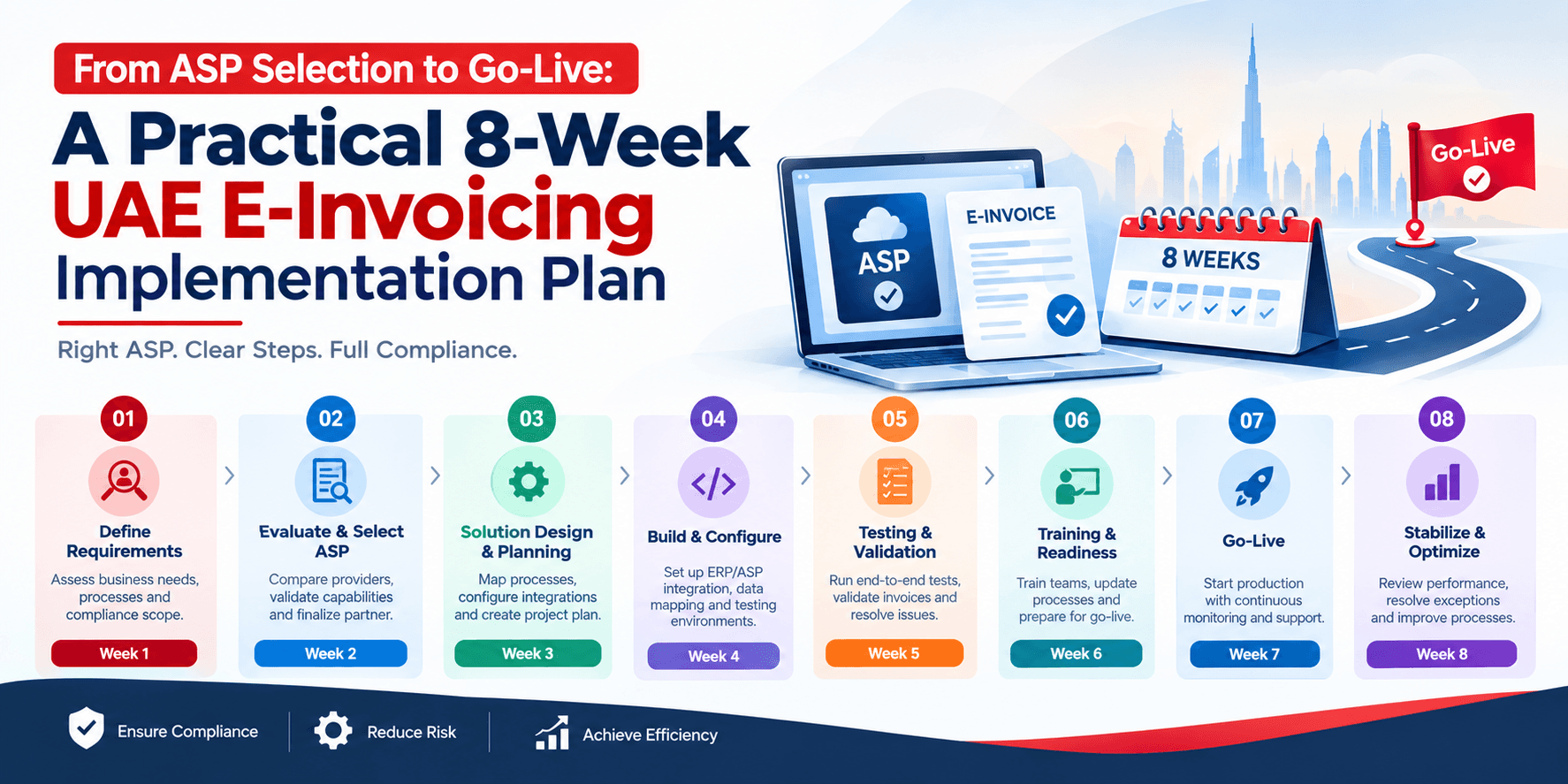
Week 1: Mobilise and confirm scope
Confirm legal entities, ERP systems, invoice sources, customer segments, volumes and target go-live. Establish a RACI across Tax, Finance, IT, security, master data and the ASP; collect representative invoices and identify special scenarios.
Week 2: Data and field mapping
Map required UAE and PINT-AE business terms to ERP sources. Classify gaps into standard fields, extensions, enrichment and process changes, then begin customer and supplier data profiling.
Week 3: Architecture and detailed design
Confirm OIC, direct API, connector or hybrid integration. Define authentication, payload, status model, message correlation, retry design, error handling and monitoring; agree where each rule belongs across ERP, middleware and ASP.
Week 4: Build and configuration
Develop outbound integration and tracking, configure mappings and entity-specific parameters, and build operational dashboards. Start the inbound AP flow as well if it is in the first phase.
Week 5: System and integration testing
Test happy paths, validation errors, timeouts, duplicate protection, callbacks and reconciliation. Resolve data and mapping defects quickly.
Week 6: User acceptance testing
Finance and Tax execute representative scenarios, including credit notes and special cases. Support teams learn to diagnose failures, while the project collects formal test evidence and sign-off.
Week 7: Cutover preparation
Complete master-data remediation, credentials, production endpoints, access, monitoring, support roster and rollback procedures. Reconcile the final list of in-scope entities and invoice sources.
Week 8: Production rollout and hypercare
Launch with controlled monitoring and review submitted, accepted, failed and pending transactions every day. Hold a short daily hypercare call until stable, then resolve recurring root causes rather than manually reprocessing the same issues.
Run essential workstreams in parallel
Do not wait for integration development before starting data clean-up, UAT preparation, support design or user training. Run regulatory and tax, ERP and data, integration, security, testing, operations and support, and change-management workstreams together.
When eight weeks is not enough
Extend the phases rather than compress testing when there are many legal entities, several ERPs, heavy customisation, weak master data, numerous invoice scenarios, complex project billing, significant inbound AP scope or slow security and change-control processes.
Final thought
The fastest safe e-invoicing implementation is the one that starts mapping, data, integration, testing and operational readiness at the same time. ASP appointment is an important milestone; go-live readiness is a separate one.
Official references
A practical eight-week implementation plan covering UAE e-invoicing architecture, mapping, ERP integration, testing, cutover and support readiness.