

Oracle Fusion, E-Invoicing
12 Oracle Master-Data Problems That Can Break UAE E-Invoicing

UAE e-invoicing can expose data-quality problems that have existed quietly for years. A PDF can look correct because templates combine free text, defaults and manually entered values; structured e-invoicing is less forgiving because required business data must exist consistently in machine-readable form.
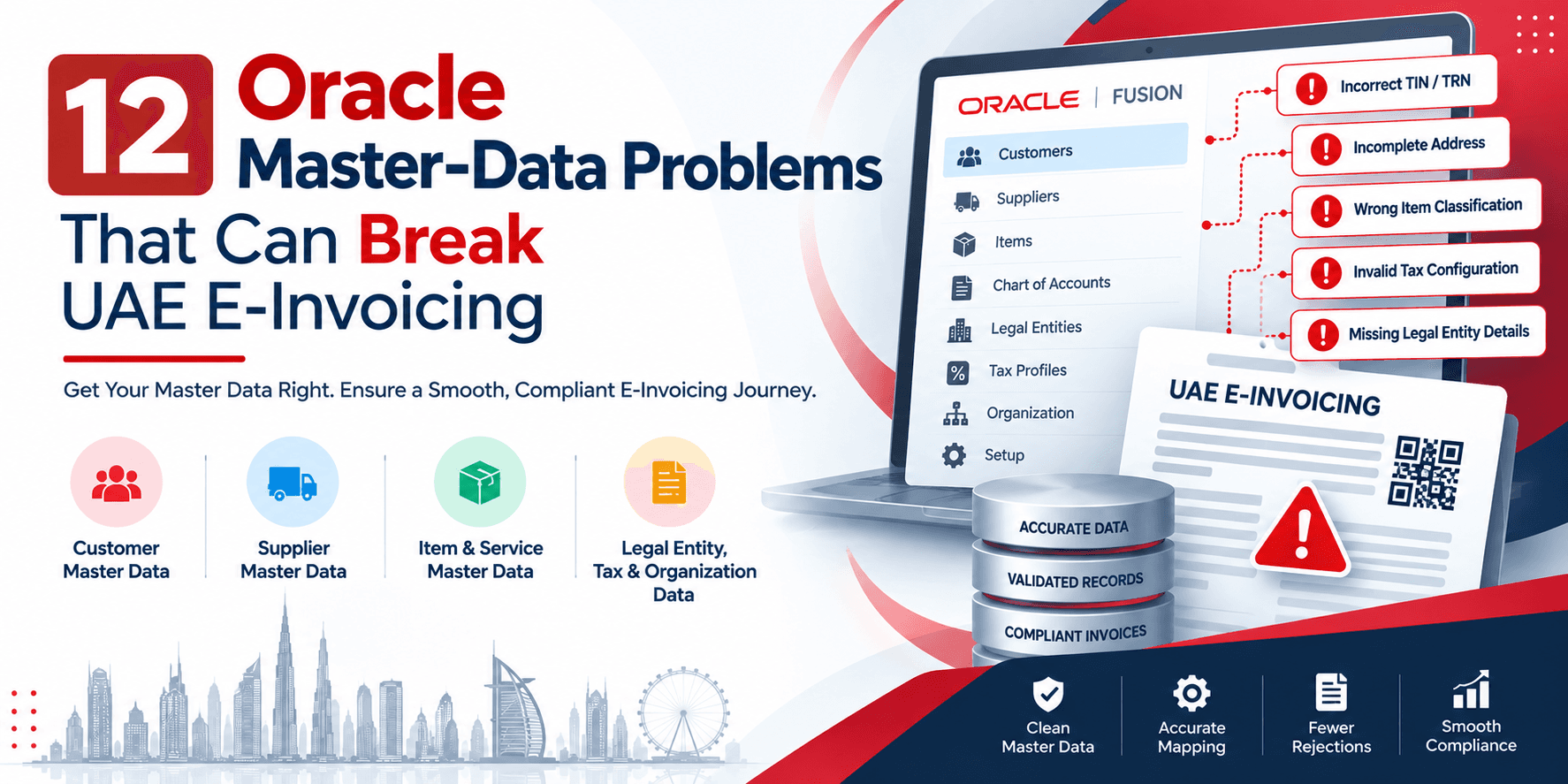
12 Oracle master-data risks to review
- Inconsistent customer legal names. Trading names, abbreviations and legal names may be mixed across accounts and sites.
- Tax identifiers stored in free text. Identifiers in notes or templates cannot be used reliably by integration.
- Missing or incomplete addresses. Older customer sites may not meet current structured-invoice data standards.
- Duplicate customer accounts. The same legal customer may hold inconsistent identifiers across multiple records.
- Wrong relationship between account and site. Confirm which Oracle level owns every billing-party and location field.
- Inconsistent supplier identification. Inbound invoices must map deterministically to Oracle suppliers and sites.
- Free-text purchase-order references. Unstructured references make automated buyer processing harder.
- Missing contract or project references. Project information may sit only in external systems.
- Tax treatment dependent on manual knowledge. Standardise the underlying rule instead of relying on user fixes.
- Entity defaults hidden in custom reports. E-invoicing needs an authoritative transaction or master-data source.
- Poor description quality. Generic descriptions may not provide the business detail customers expect.
- Old inactive records still used. Historical sites may remain selectable even when identifiers are outdated.
Run a data-profiling exercise
Do not review ten hand-picked customers and assume readiness. Profile the full population for missing values, duplicates, invalid formats, inconsistent legal names, recently used inactive sites and entity-specific anomalies. Prioritise remediation by invoice volume and business criticality.
Assign data owners
IT can identify missing fields but should not decide the correct legal name or tax identifier. Assign responsibility to customer master, supplier master, Tax, Finance or the relevant business team.
Prevent bad data from returning
One-time clean-up is not enough. Update onboarding and maintenance processes so new customers and suppliers meet the e-invoicing standard, with validations and approval rules where appropriate.
Final thought
In many UAE e-invoicing projects, integration development gets attention while master data becomes the real critical path. Start profiling now: a connector cannot compensate for information the business never captured correctly.
Official references
Twelve customer, supplier and transaction-data issues Oracle teams should fix before UAE e-invoicing go-live.