

E-Invoicing, UAE
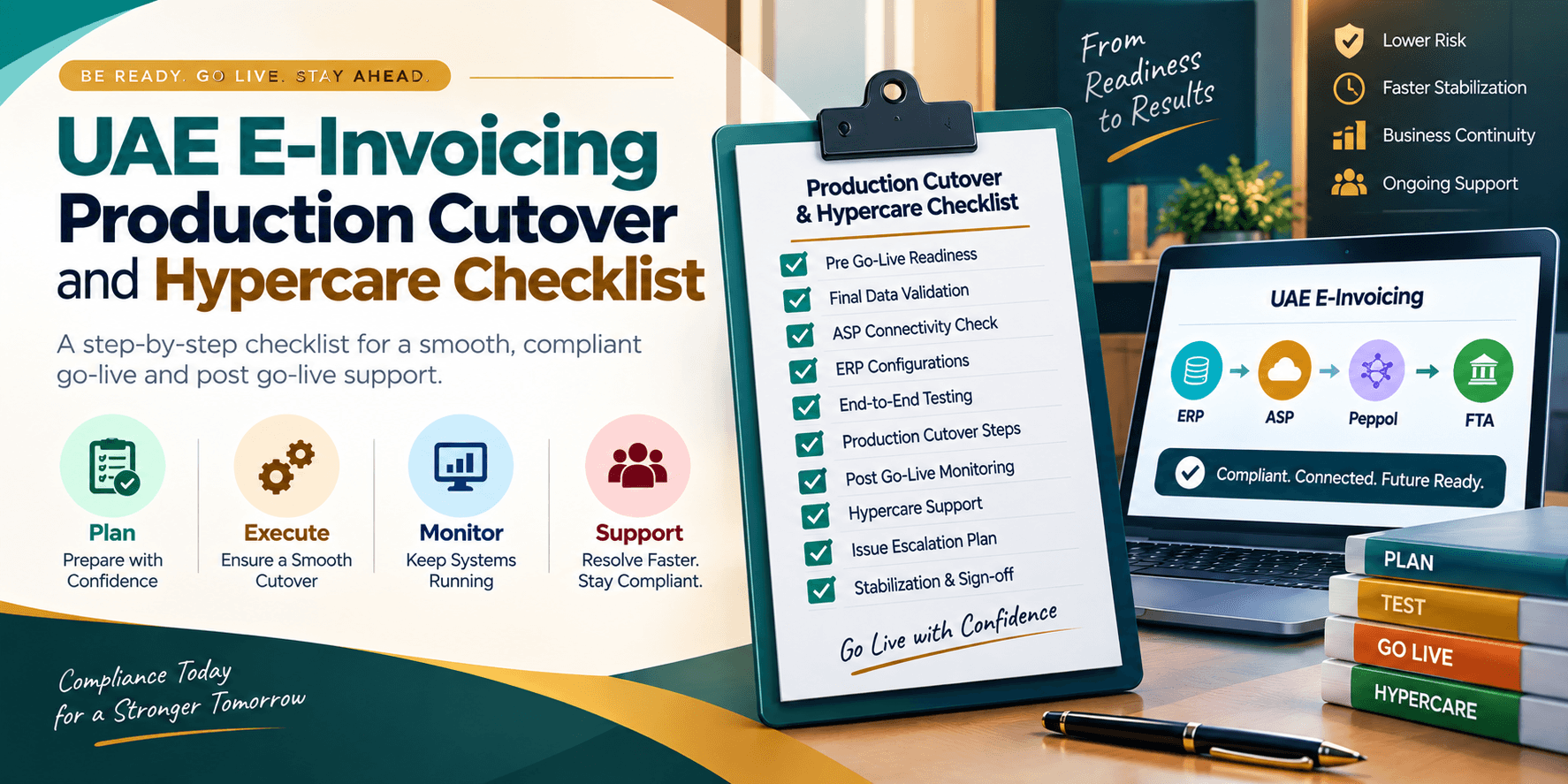
UAE E-Invoicing Production Cutover and Hypercare Checklist

A UAE e-invoicing solution can pass UAT and still struggle in production if cutover is treated as a technical deployment only. The go-live checklist must cover business readiness, data, security, support and daily reconciliation not just whether the interface package was promoted.
1. Scope confirmation
Confirm the final legal entities, Business Units, transaction sources and document types included in the go-live wave. Freeze last-minute scope additions unless they are critical.
2. Production credentials and connectivity
Validate production endpoints, certificates and credentials, network rules, secrets storage and expiry dates. Test connectivity before the first live invoice.
3. Master-data readiness
Confirm priority customers and suppliers have been remediated and that new onboarding controls are active.
4. Production configuration
Review entity identifiers, mapping tables, endpoints, notification lists and feature flags. Use maker-checker or peer review for critical production configuration.
5. Monitoring
Ensure dashboards and alerts are active for submission failures, validation errors, pending messages, callback failures, unusual volume drops or spikes, and credential or connectivity issues.
6. Reconciliation reports
Run a report comparing in-scope ERP transactions to e-invoicing submission status. Agree who reviews it and how often.
7. Support model
Publish contacts and escalation paths for Finance processes, master data, ERP, integration, ASP or network issues, and tax-interpretation questions.
8. Known-error playbook
Document common failures and the correct action, including missing identifiers, invalid references, duplicate submissions, timeouts, unmapped suppliers or customers, and callback failures.
9. Controlled first transactions
Use selected first-production transactions that can be monitored closely. Confirm their end-to-end status before scaling volume.
10. Hypercare dashboard
During the first days, review total eligible ERP invoices, submitted, successful, failed, pending, manually corrected, duplicated and unmatched responses. This gives management a simple view of stability.
11. Daily hypercare meeting
Keep it short: review critical errors, ageing transactions, root causes, owners and actions. Do not turn it into a general project-status meeting.
12. Measure recurring defects
If the same validation error recurs, fix the source process or master data instead of relying on manual correction.
13. Confirm business continuity
Know what the business does if ERP, middleware or provider connectivity is unavailable. The procedure must reflect official requirements and the approved continuity plan.
14. Close hypercare based on stability, not date
Exit hypercare only when transaction success, reconciliation and support processes are stable for an agreed period.
Final thought
Go-live is where earlier design quality becomes visible. A good cutover plan gives Finance confidence that every invoice can be traced, every failure has an owner and the organisation can prove what happened to each transaction.
Official references
A production cutover and hypercare checklist for UAE e-invoicing covering data, ERP, integrations, ASP, security, support and reconciliation.