

Oracle Fusion, E-Invoicing
How to Avoid ASP Vendor Lock-In in UAE E-Invoicing Integration?

Selecting an e-invoicing provider for years is reasonable, but the integration architecture should still make change possible. Vendor lock-in becomes a problem when ERP logic is provider-specific, mappings are not customer-owned and moving requires rebuilding the complete process.
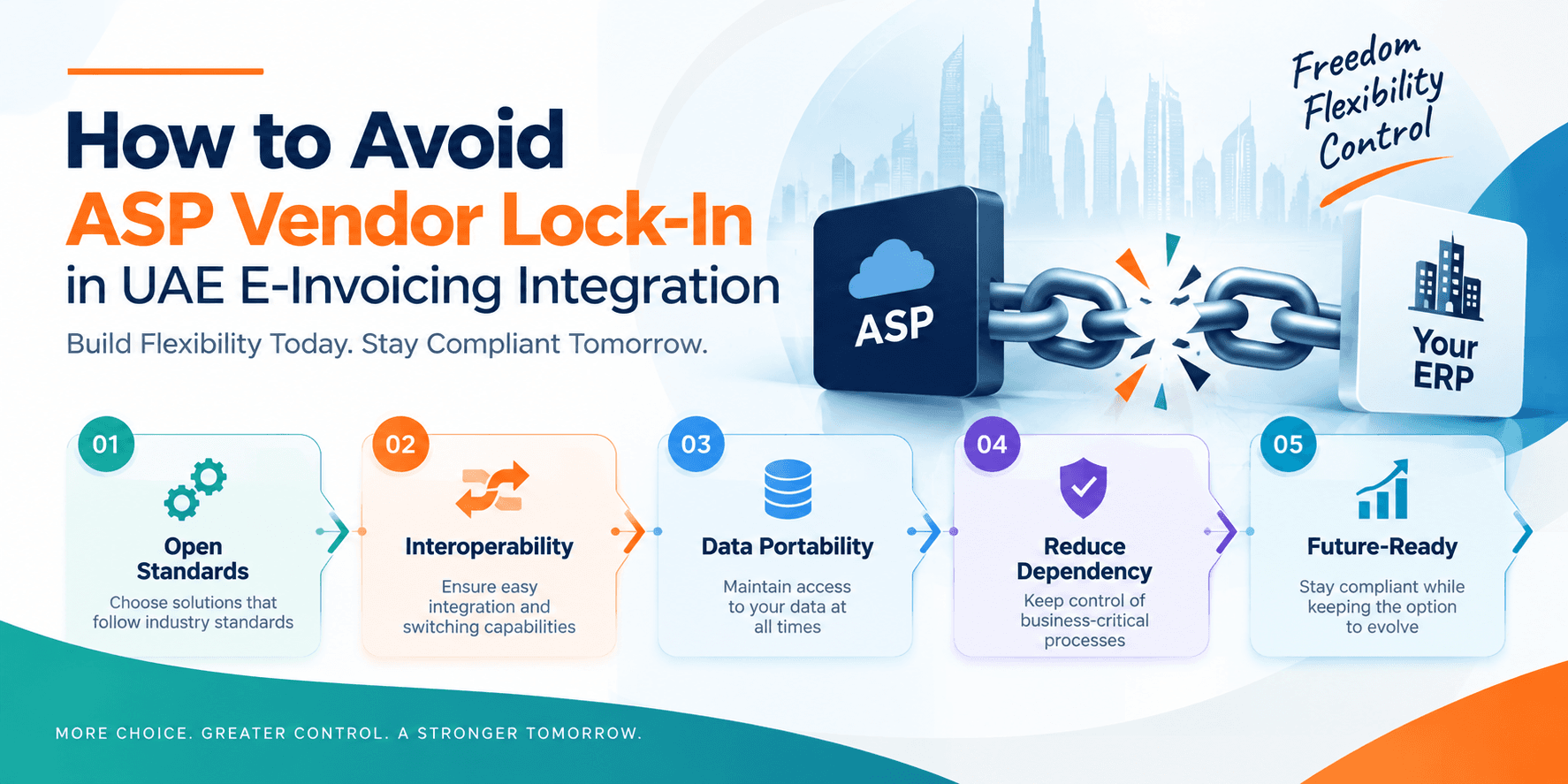
Keep the ERP model separate from the ASP model
Oracle, NetSuite, SAP or another ERP should remain the business system of record. Avoid filling it with provider-specific technical fields unless they are genuinely needed operationally. Store ASP metadata in an integration or tracking layer where practical.
Create a canonical invoice model
For complex organisations, define an internal canonical representation of the invoice. It does not need to replicate the full PINT-AE schema; it should represent the business data exchanged consistently across systems. Maintain transformations from ERP to canonical model and from canonical model to ASP API. If the provider changes, the second transformation changes more than the ERP extraction.
Own the mapping documentation
Do not let the only Oracle-to-e-invoicing mapping live in a vendor's proprietary tool. Maintain an approved mapping matrix with the source field, business meaning, transformation and requirement. It remains valuable even if the provider never changes.
Use stable correlation IDs
Your internal transaction key should not depend entirely on an ASP message ID. Store both so the enterprise audit trail remains intact when external systems change.
Separate business and provider statuses
Map provider-specific events to a smaller internal status model Finance understands, such as Submitted, Accepted, Failed, Delivered and Action Required. This reduces downstream dependency on a single API vocabulary.
Treat connectors carefully
A packaged connector can accelerate delivery, but understand whether mappings can be exported, configurations are documented, another ASP can reuse the ERP-side integration, custom code is customer-owned, and what happens if the connector is discontinued.
Keep raw messages for audit and troubleshooting
Where permitted by architecture and retention policy, keep outbound and inbound message evidence for reconciliation and investigation. The ASP portal should not be the only place where historical transaction detail exists.
Avoid over-engineering
ASP portability does not justify a huge abstraction platform for a simple implementation. The goal is controlled separation, not unnecessary complexity. For many customers, a well-designed OIC layer with configuration-driven mappings and clean status tracking is enough.
Final thought
The best time to consider portability is before the first integration is built. Clear boundaries between ERP, middleware and ASP give the organisation more control even if the same provider remains for many years.