

Oracle Fusion, E-Invoicing
UAE E-Invoicing with Oracle Fusion: From AR Invoice to ASP, Peppol and FTA

For Oracle Fusion customers, UAE e-invoicing is not simply a new invoice format. It changes how invoice data leaves Oracle, how it is validated, how it is exchanged with buyers, how tax data is reported, and how status messages come back into the ERP landscape.
The most important design decision is not only which XML to generate. It is what the end-to-end transaction architecture should look like.
Start with the actual business flow
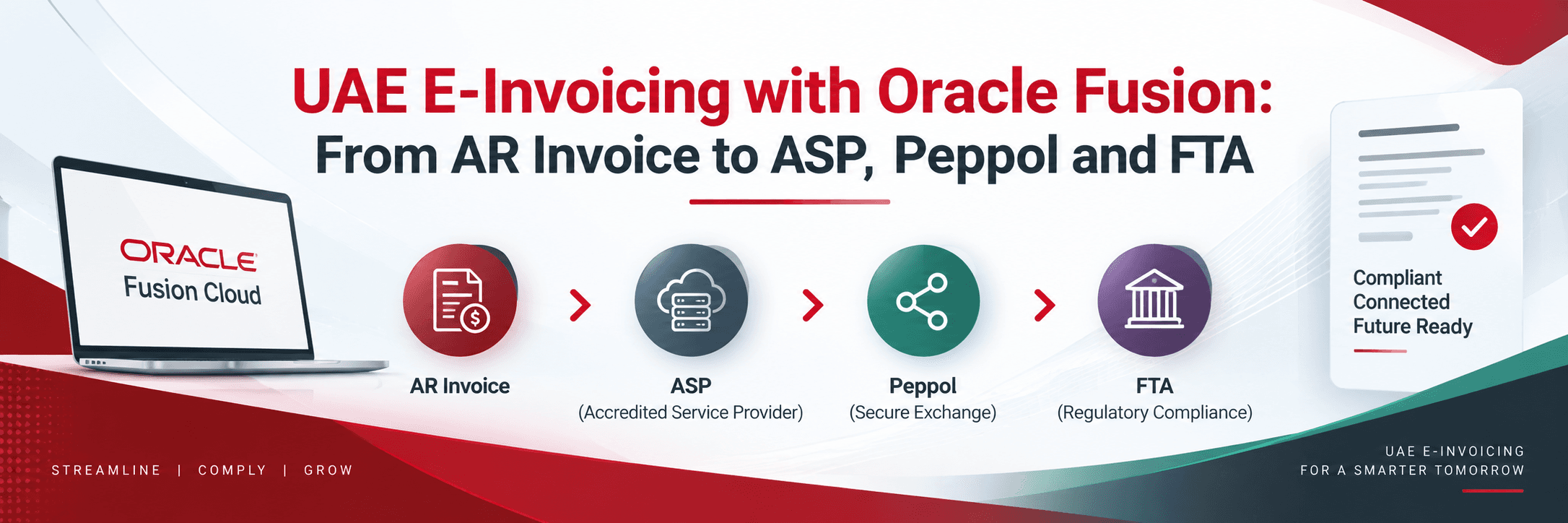
A typical outbound flow begins in Oracle Fusion Receivables. A tax invoice or commercial invoice can be created from an order, project billing event, subscription, manual transaction or another upstream process. Oracle remains the system of record for the commercial transaction.
Relevant invoice data moves to the selected UAE Accredited Service Provider (ASP), which performs the required validation and network exchange. The invoice is transmitted through the Peppol-based exchange model to the buyer's service provider, while prescribed tax data is reported to the Federal Tax Authority.
The response path matters equally. Validation results, delivery status and business-response messages should not remain trapped in an external portal. Finance needs to know whether an invoice was accepted, rejected, failed technically or requires intervention.
Where Oracle Fusion fits
Oracle Fusion should continue to own the accounting transaction, customer master, tax determination, invoice number, date, currency, line values and references to originating documents. UAE requirements may need data not always captured cleanly in a standard invoice flow, including buyer identifiers, additional party details, payment information, references and scenario-specific information.
Before building an interface, map each UAE field to one of four categories:
- Available in standard Oracle fields.
- Available elsewhere in Oracle but not on the invoice transaction.
- Available in an upstream system and needs to be carried into Fusion.
- Not currently captured and requires a process or configuration change.
This mapping exercise is normally more important than the API development itself.
OIC, direct APIs or another integration layer?
Oracle Integration Cloud (OIC) is a natural choice for many Fusion customers because it already sits between Oracle and surrounding applications. It can extract invoice data, enrich it, call the ASP API, process asynchronous responses and update status back into Oracle or an operational dashboard.
However, OIC should not automatically become the place where every UAE e-invoicing rule is hard-coded. A practical separation is:
| Layer | Responsibility |
|---|---|
| Oracle Fusion | Source transaction and accounting data. |
| Integration layer | Orchestration, mapping, enrichment, security, retries and monitoring. |
| ASP platform | UAE e-invoicing validation, Peppol exchange and regulatory connectivity. |
This makes future regulatory changes easier to manage and reduces dependency on Oracle customisations.
Do not design only the outbound flow
Projects often start with Accounts Receivable because the organisation is focused on issuing compliant invoices. The UAE model is also an opportunity to improve Accounts Payable. As structured invoices arrive from suppliers, the architecture can identify suppliers, validate purchase-order references, create or stage AP invoices and support matching against purchase orders and receipts.
Status and reconciliation need their own design
A production design should answer which Oracle invoice produced each e-invoice, whether the ASP accepted it, whether it was delivered, whether a business response was received, who owns corrections and how safe reprocessing prevents duplicates.
Use an immutable correlation ID between Oracle, the integration layer and the ASP. Store external message IDs and timestamps against the transaction or in a dedicated tracking store. This is critical during month-end reconciliation.
Security and support are part of the architecture
Include API authentication, credential rotation, data encryption, audit logging, monitoring, business continuity and support ownership. E-invoicing is a production-critical finance integration, not a one-time tax project, and should be reviewed by Finance, Tax, IT integration, security and support teams together.
A practical target architecture
Oracle Fusion AR → OIC/integration layer → UAE ASP → Peppol exchange → buyer ASP
Tax reporting is handled as part of the ASP's compliant UAE flow, and responses return through ASP → OIC/integration layer → Oracle/status dashboard. Keep Oracle as the transactional source of truth, regulatory exchange with the ASP, and a transparent integration layer between them.
Final thought
The risk in UAE e-invoicing is rarely the ability to create XML. It is discovering too late that master data is incomplete, invoice scenarios were not mapped, responses cannot be reconciled or operational teams do not know how to handle failed transactions. Solve these issues during architecture and data mapping, before development is complete.
Read the UAE e-invoicing readiness, timeline and ASP guide for Oracle Fusion, the UAE e-invoicing data dictionary guide, and practical business challenges and readiness.