
Oracle Fusion, E-Invoicing
Inbound UAE E-Invoicing: Supplier Invoices into Oracle Fusion Payables

Most UAE e-invoicing projects start with outbound invoices. For Oracle Fusion customers, the larger operational opportunity may be inbound: structured supplier invoices can reduce manual entry, improve validation and create a cleaner path to Accounts Payable processing.
A machine-readable invoice arrives with supplier, invoice, line, tax and reference information instead of starting with an image or PDF. It does not automatically create a perfect AP process, but it removes a major source of manual capture.
What changes compared with email and PDF invoices?
In a traditional process, suppliers email PDF invoices. AP teams or OCR tools extract data, identify suppliers, capture invoice lines and try to match the invoice to a purchase order and receipt. Structured e-invoicing changes the starting point by delivering machine-readable data through the approved exchange model.
A practical inbound architecture
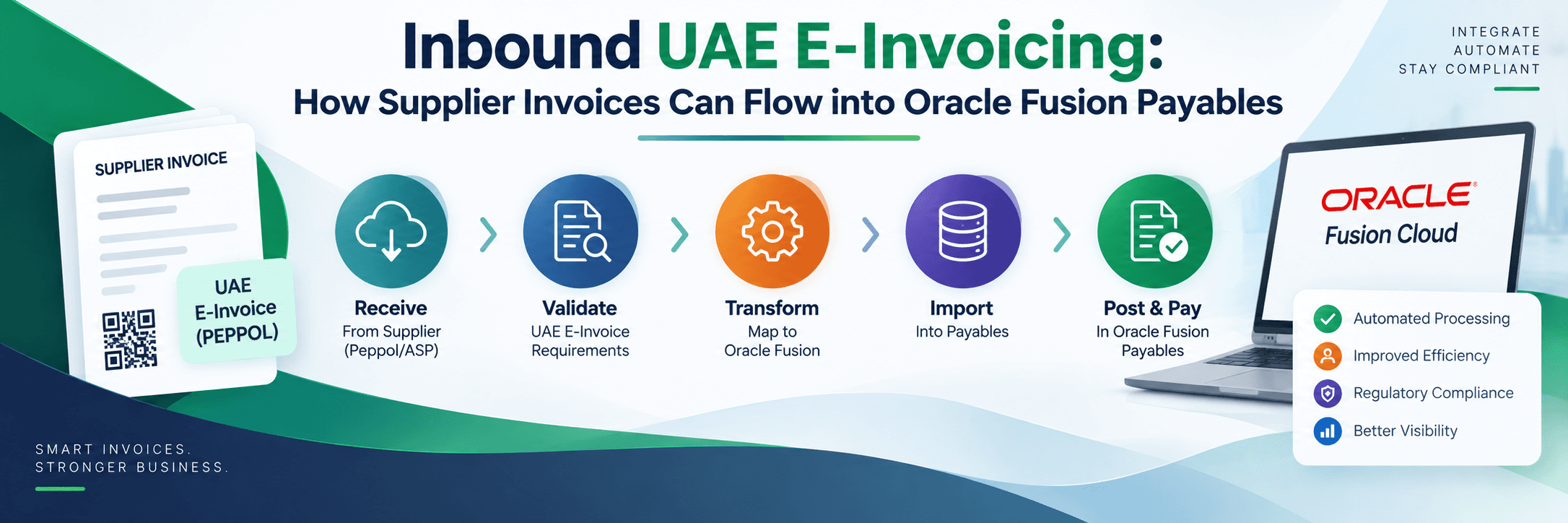
Supplier → supplier ASP → Peppol exchange → buyer ASP → integration layer → Oracle Fusion Payables
The integration layer can validate and stage the invoice before Oracle creation.
- Receive the structured invoice and technical metadata.
- Identify the supplier in Oracle.
- Validate legal entity, supplier site and currency.
- Read PO, contract or other references.
- Apply duplicate checks and map tax/accounting data.
- Create the AP invoice or route it to an exception queue.
- Trigger Oracle approval and matching.
Supplier identification is fundamental
The inbound process must connect the electronic supplier identity to the correct Oracle supplier and supplier site. Avoid matching only on supplier name: names vary and can create false matches. Use stable identifiers and maintain explicit mappings before high-volume production begins.
PO invoices can become more automated
Structured invoices can carry purchase-order references and line details, enabling matching against Oracle POs and receipts. Define exception handling for missing or closed POs, wrong lines, quantities exceeding receipts, price differences beyond tolerance, tax mismatches and multiple receipts. Aim for high straight-through processing of clean invoices with a clear exception path for everything else.
Non-PO invoices still need workflow
Structured data does not remove business approval. Non-PO invoices may still need cost centre, account, project or approver information before posting. Route them into controlled AP workflow rather than bypassing governance.
Duplicate prevention and attachments
Duplicate checking should use supplier, invoice number, legal entity, amount and date, plus the external e-invoice message identifier. This matters when the same supplier invoice reaches AP through more than one channel during transition.
Supporting documents such as timesheets, delivery evidence and contract attachments are different objects from the structured invoice. Design how they link to Oracle AP without making the e-invoice dependent on manual email handling.
Build an exception dashboard
AP teams should see received invoices, successfully created AP invoices, duplicate candidates, supplier-mapping errors, PO or receipt exceptions, tax-validation issues and invoices awaiting business action. This is more useful than requiring finance users to search integration logs.
Why this matters beyond compliance
Structured inbound invoices can improve AP productivity, reduce capture errors and provide better transaction visibility. For Oracle Fusion customers, this is where a compliance project can become an automation programme.
Final thought
If a UAE e-invoicing project stops after sending outbound invoices, it solves only half the opportunity. Designing inbound supplier invoice processing early can produce a measurable operational return beyond compliance.
Read the UAE e-invoicing readiness guide for Oracle Fusion and practical business challenges and readiness.