

E-Invoicing, UAE
OIC vs Direct API vs ERP Connector for UAE E-Invoicing

Once a business selects a UAE e-invoicing service provider, the next question is usually how its ERP should connect to it. The right architecture depends on the ERP landscape, integration standards, internal skills, transaction volumes and the level of control needed for mapping and monitoring.
For Oracle customers, three common approaches are Oracle Integration Cloud (OIC), direct API integration and a packaged ERP connector. There is no single correct answer.
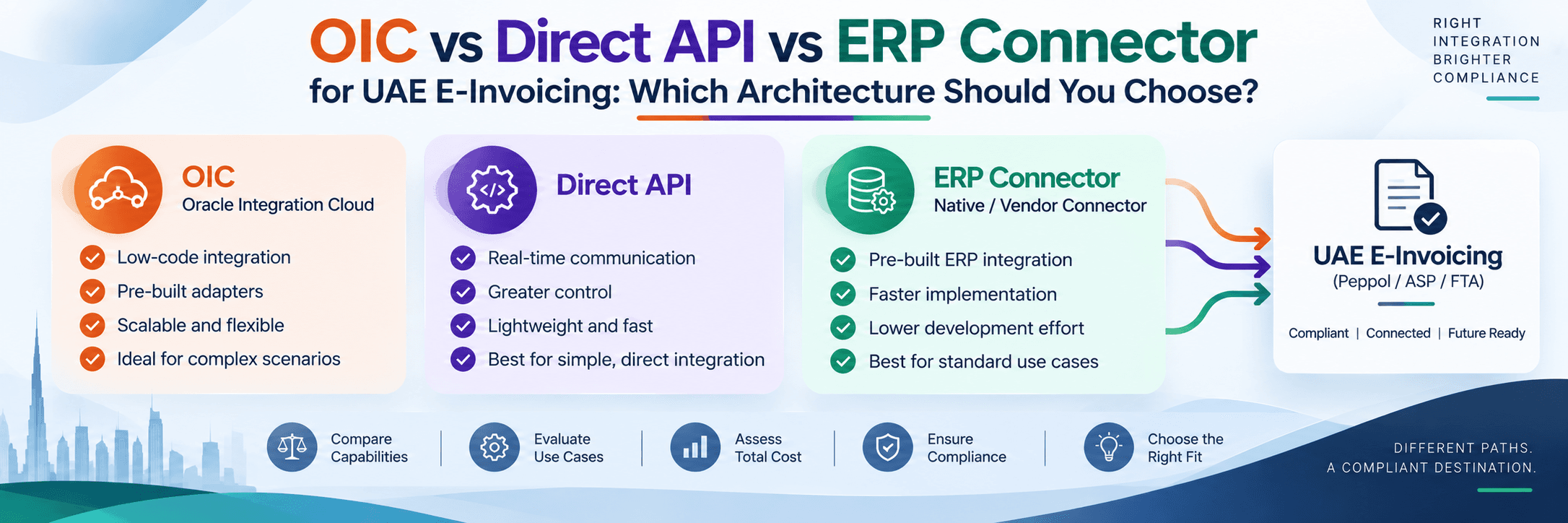
Option 1: Oracle Integration Cloud
OIC is often the natural choice when an organisation already uses it for Fusion integrations. A typical design can extract or receive invoice data from Oracle, enrich missing values, transform the message into the ASP's expected API structure, invoke the ASP securely, process asynchronous responses, manage retries and send status back to Oracle or a monitoring dashboard.
Advantages
OIC keeps integration logic within the organisation's established Oracle integration platform. It provides monitoring, orchestration and reusable connections to Fusion.
Watch-outs
Do not turn OIC into a custom regulatory engine. Recreating every PINT-AE rule and regulatory validation in integration code can make maintenance unnecessarily complex. Use OIC primarily for enterprise orchestration and leave UAE network and regulatory responsibilities to the ASP where appropriate.
Option 2: Direct API from the ERP or custom application
A direct API approach can suit custom ERPs, billing platforms or applications that can securely call the ASP's API themselves.
Advantages
It can reduce the number of moving components and work well for a modern application with a strong development team.
Watch-outs
Direct integration can couple the business application tightly to the ASP. Authentication, retry management, logging, version changes and asynchronous callbacks all need to be handled properly. Changing ASP later may require more application code to be rewritten.
Option 3: Packaged ERP connector
Some providers offer connectors for specific ERPs. This can accelerate implementation when the connector genuinely covers the customer's version, processes and transaction scenarios.
Advantages
Potentially faster deployment, pre-built mappings and less custom development.
Watch-outs
A connector should not be treated as a black box. Confirm the invoice scenarios supported, custom-field handling, mapping options, error visibility, response write-back, maintenance responsibility after ERP or regulatory updates, and the impact of changing ASP later.
A hybrid model is often best
Large enterprises frequently use a hybrid architecture: a connector or standard extraction handles ERP connectivity, an integration layer performs orchestration, and the ASP manages e-invoicing compliance and Peppol exchange. This creates a clear separation of responsibilities.
Decide based on six criteria
- Existing integration standard: if OIC is the approved Oracle middleware, a separate e-invoicing pattern can increase support complexity.
- Customisation level: highly customised invoice processes usually need more flexible mapping and enrichment.
- Number of ERPs: groups with Fusion, EBS, NetSuite and other billing applications benefit from a common integration pattern.
- Operational monitoring: finance needs transaction-level visibility without requiring developers to read logs.
- Vendor portability: retain a canonical internal invoice model where practical to lower the cost of changing ASPs or supporting more destinations.
- Support ownership: define who owns Oracle extraction, middleware, ASP connectivity and business exceptions.
Final thought
The best UAE e-invoicing architecture is not necessarily the one with the fewest components. It is the one your organisation can operate, monitor and change safely for years. Choose the pattern based on long-term supportability, not only the fastest proof of concept.
For the UAE framework context, read UAE Electronic Invoicing Guidelines: Scope, Roles & Readiness. For Oracle Fusion implementation planning, see the UAE e-invoicing readiness, timeline and ASP guide.