

Oracle Fusion, E-Invoicing
25 UAE E-Invoicing UAT Scenarios Every Enterprise Should Test Before Go-Live

A successful API test is not the same as successful user acceptance testing. UAE e-invoicing touches Finance, Tax, master data, integrations, security, service-provider connectivity and operational support. UAT needs to prove the complete business process, including failures.
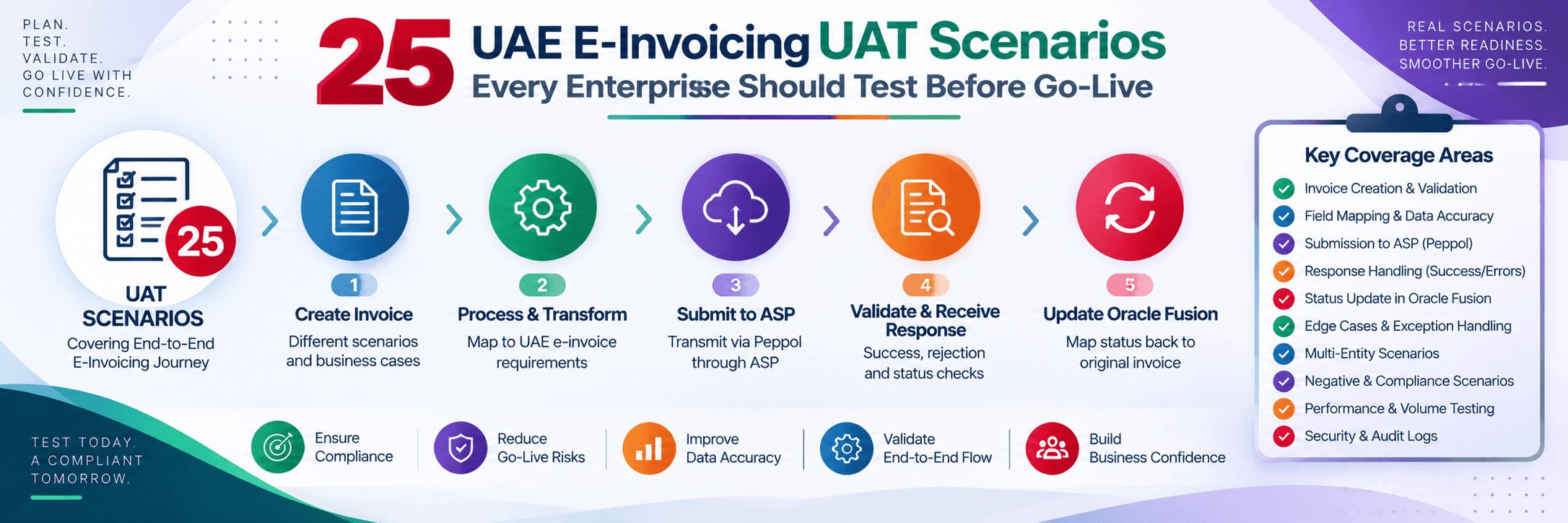
Core outbound scenarios
- Standard domestic tax invoice with one line.
- Multi-line invoice with different item or service descriptions.
- Line- or document-level discounts and additional charges where used.
- Foreign-currency invoice.
- Invoice from an upstream system and a manual AR invoice.
- Purchase order, contract or customer reference.
- High-value invoices near internal limits.
- Long descriptions and special characters.
Correction and special-business scenarios
- Full credit note against an earlier invoice.
- Partial credit note.
- Correction after a validation failure.
- Reversal or cancellation where relevant.
- Advance-payment transaction.
- Retention or project billing where applicable.
- Multi-entity transaction from another UAE legal entity.
- Transaction from another Business Unit or invoice source.
Failure, recovery and reconciliation
- Mandatory field missing before submission.
- ASP or API validation rejection.
- Temporary network or endpoint outage.
- Timeout after submission with an unknown ASP outcome.
- Duplicate submission attempt.
- Response that cannot initially match an internal invoice.
- End-of-day reconciliation proving every completed in-scope ERP invoice has a final e-invoicing status or documented exception.
Add inbound scenarios where relevant
For inbound AP, test supplier identification, PO and receipt matching, non-PO approval, duplicate supplier invoices, tax mismatch and attachment handling. A common inbound queue is not enough without clear entity and supplier routing.
Test more than the happy path
Production problems usually arise from exceptions. Deliberately test invalid identifiers, missing addresses, wrong tax details, an unavailable ASP, duplicate invoices, unexpected responses, delayed callbacks and expired credentials. The goal is to prove safe detection, understanding and recovery.
Define expected results before testing
Every UAT case should state its preconditions, source transaction, expected structured output, expected ASP response, expected ERP status, accounting impact, user action, evidence, tester and approver. This makes sign-off meaningful.
Include Finance, Tax and support
Do not let UAT become only an integration-team exercise. Finance should confirm invoice accuracy, Tax should confirm treatment, IT should confirm reliability, and support teams should understand how to diagnose problems after go-live.
Test volume and recovery
Run controlled volume testing and confirm throughput, queue behaviour, API limits, retry handling, monitoring, restart after outage and reconciliation after restart. Retain the source invoice, structured message, response, ERP status and supporting evidence for every approved test.
Final thought
The purpose of UAT is not to prove that a project team can create a successful invoice. It is to prove that the business can operate e-invoicing every day, including when things go wrong.