
Oracle Fusion, E-Invoicing
UAE E-Invoicing Responses and MLS: Oracle Invoice Status Mapping

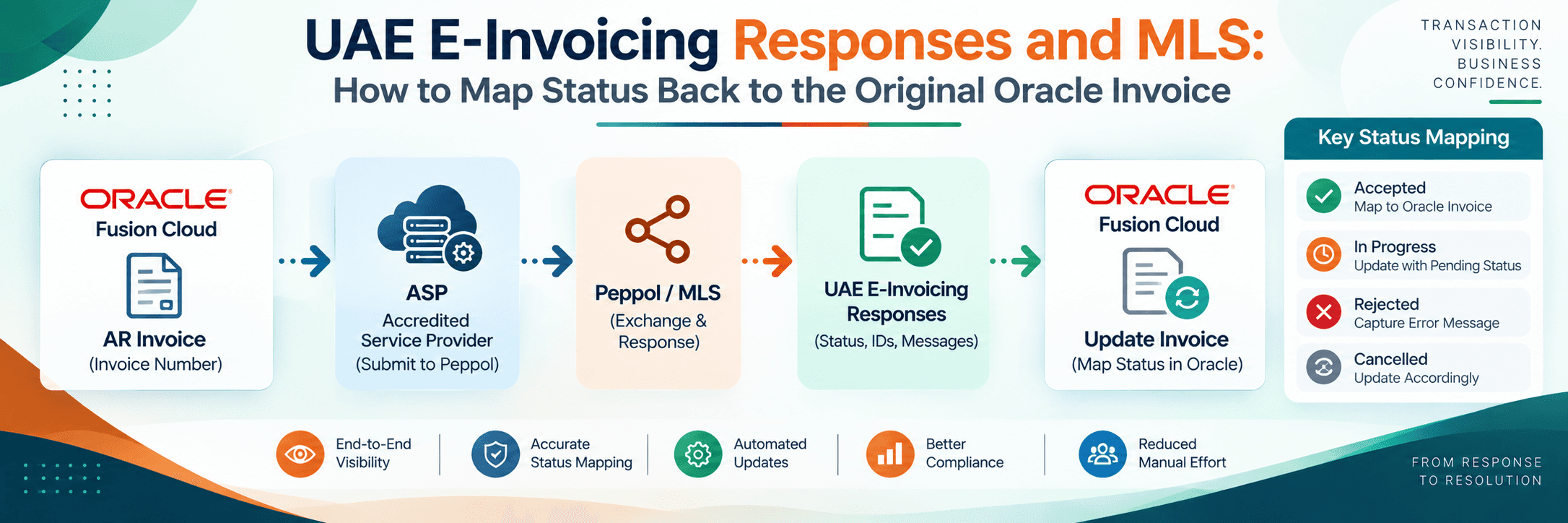
Sending an e-invoice is only one part of its lifecycle. When a response returns, the operational question is which Oracle invoice it belongs to and what action must happen next. At volume, manual lookup does not work.
Use a correlation strategy from day one
Every outbound invoice needs an internal correlation key before it leaves the ERP. Store Oracle transaction ID, invoice number, legal entity or Business Unit, integration message ID, ASP submission ID, Peppol message ID where available, response ID and timestamps together. Never rely only on invoice-number text inside a response.
Separate technical status from business status
A successful HTTP response does not mean the invoice completed its business lifecycle. Use Finance-friendly states such as Ready for submission, Submitted to ASP, Validation failed, Accepted by ASP, Sent to network, Delivered, Business response received, Failed and awaiting correction, and Cancelled or reversed where applicable.
MLS and response messages need deterministic routing
When a Message Level Status (MLS) or another structured response arrives, extract available identifiers and match them to the outbound record. Route unmatchable messages to an exception queue and retain the full payload for investigation.
Maintain an e-invoicing tracking table
A dedicated tracking table or service can record transaction key, document type, source system, legal entity, outbound payload version, ASP message ID, current status, error code, error message, retry count, timestamps and last action. It provides a full audit trail without overloading the ERP with technical details.
Design retry rules carefully
A retry must not create a duplicate e-invoice. Distinguish requests that never reached the ASP, are pending, require data correction, encountered temporary network issues or triggered duplicate detection. Query provider status or use an agreed idempotency mechanism before resubmitting.
Show status where users work
AR users should not have to use OIC monitoring or API logs. A lightweight Oracle extension or operational dashboard should show the latest e-invoicing status, submission time, error reason, correction requirement and next-action owner.
Reconciliation should be a daily control
Compare completed Oracle invoices against successful submissions and highlight invoices never submitted, pending too long, rejected, duplicated, or reversed without downstream handling. This is particularly important around period close.
Final thought
E-invoicing is message-driven. Design the status and reconciliation model before go-live, not after the first production failure.