

Oracle Fusion, E-Invoicing
Credit Notes and Corrections in UAE E-Invoicing: What Oracle Teams Should Design

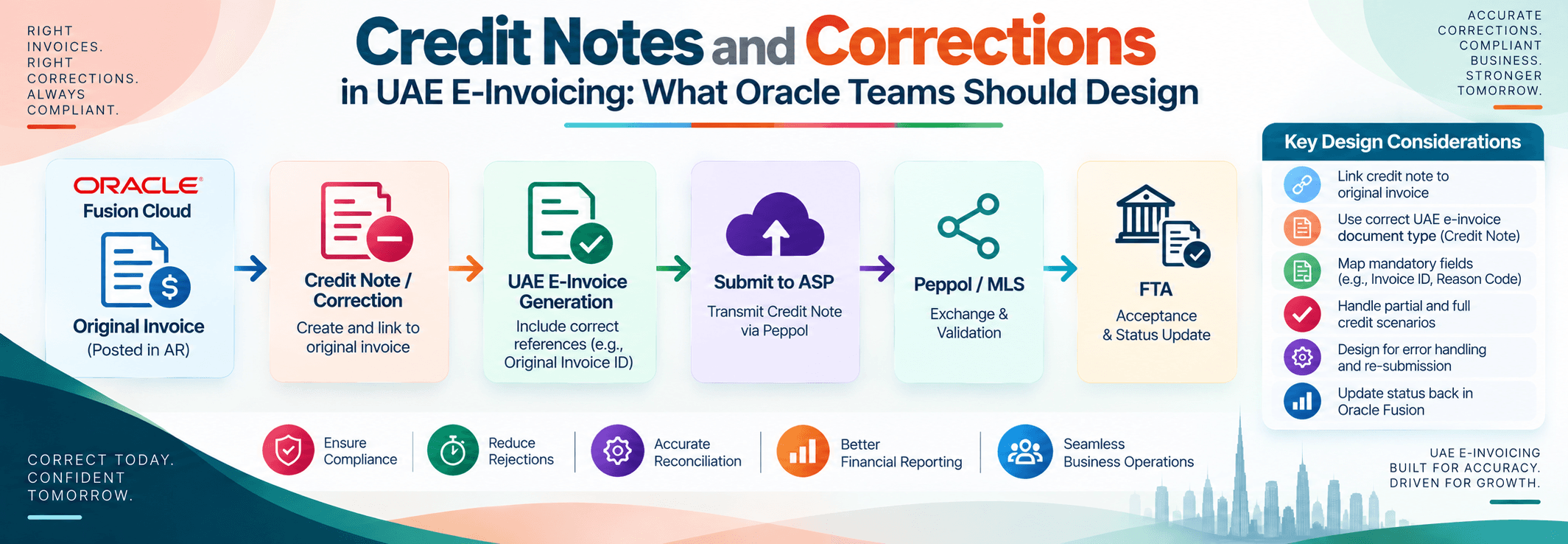
Credit notes look simple until they need to move through an electronic invoicing network. An Oracle credit memo may be familiar accounting, but the e-invoicing design must preserve its relationship to the original invoice, transmit structured data and keep its operational status traceable.
Map business reasons first
Identify every reason the organisation issues a credit note: pricing correction, returned goods, cancelled service, quantity correction, contractual adjustment, post-invoice discount and tax correction where applicable. Different Oracle sources can create credit notes differently, so map all transaction sources rather than only the standard manual process.
Preserve the original-invoice reference
Where a business scenario requires a reference to an earlier invoice, ensure the original transaction identifier is available in a consistent Oracle field and can be extracted for e-invoicing. Do not depend on a user typing an invoice number into free text.
Give the credit note its own lifecycle
A credit note is a new e-invoicing transaction. It needs its own message IDs, responses, status and reconciliation record while maintaining the link to the original document. Updating only the original invoice status is not enough.
Test partial credits carefully
Partial credits can expose mapping errors in quantity, taxable amount, tax and discount logic. The structured data should reflect the actual Oracle accounting transaction; Oracle remains the source of truth for the financial document.
Separate correction from rejection handling
Define the difference between correcting data before a valid transaction is completed and issuing a genuine accounting credit note after an invoice exists in the business process. Credit notes should not become a generic workaround for technical errors.
Give Finance linked visibility
Finance should be able to view the original invoice, its e-invoicing status, every related credit note and each credit-note status. This is essential when multiple adjustments are raised against one invoice.
Include these UAT cases
- Full and partial credit notes.
- Multiple credit notes against one invoice.
- Credit notes from different transaction sources.
- Foreign-currency credit notes.
- Credit notes following earlier response or error scenarios.
- Invalid or missing original references.
- Safe retry without duplication.
Final thought
Credit notes are a normal finance operation, not an edge case. Design them as a first-class e-invoicing process from the beginning, or late testing will expose assumptions that should have been solved in the architecture and data model.