Who Actually Owns Oracle Fusion at Your Company?

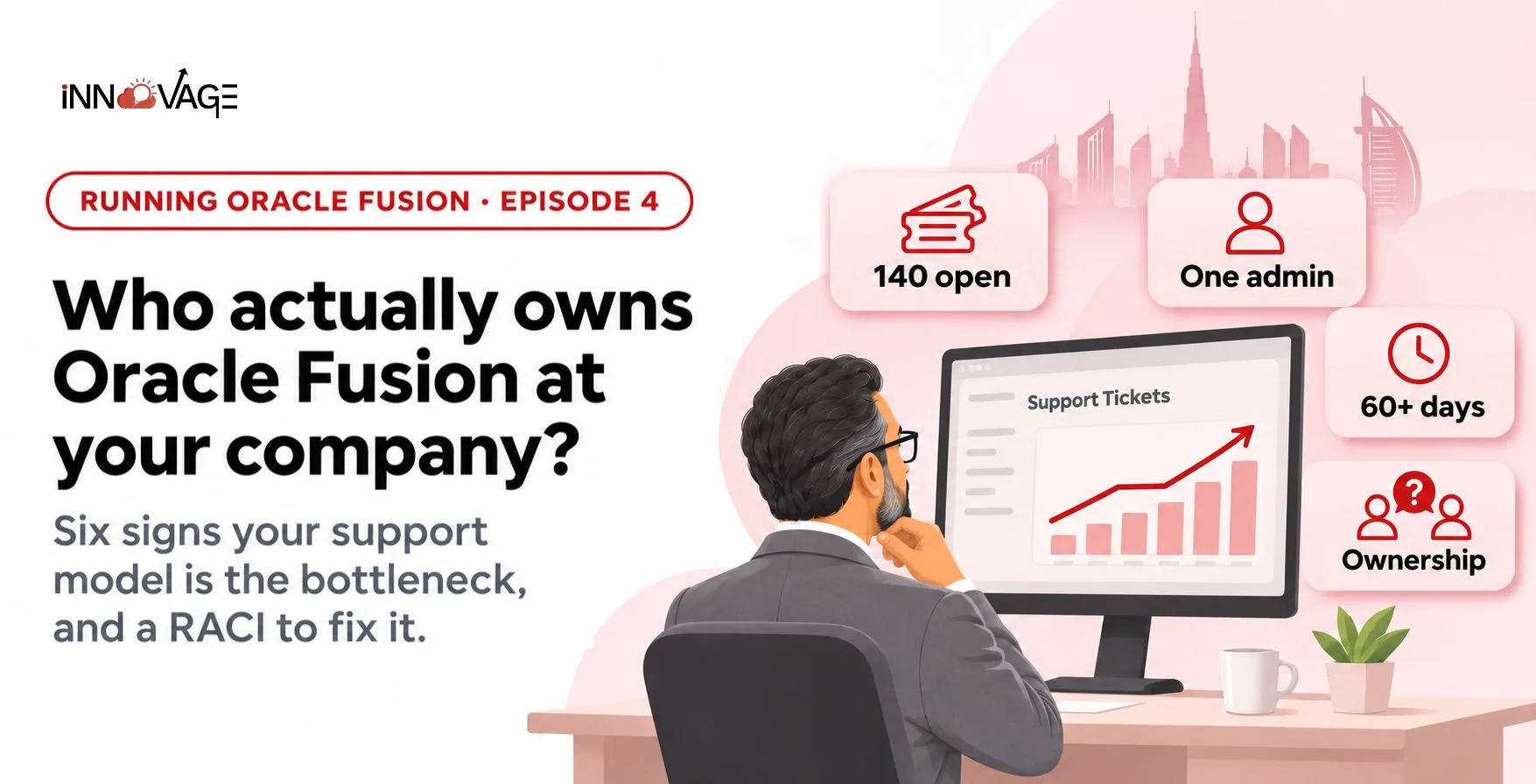
Previously, in Episode 3: the quarterly update went live on a Friday in Dubai, and by Monday the supplier invoice interface had failed. This week, the CIO.
Key takeaways
- When Oracle Fusion keeps causing the same problems years after go-live, the cause is usually the support model, not the software.
- A ticket-only support contract keeps Fusion running but never makes it better. Nobody is paid to improve it.
- Six signs show up again and again: a growing backlog, one overloaded admin, repeat tickets, workarounds by each team, untested updates and no roadmap.
- A simple RACI that names who owns what across finance, IT, the ERP lead and the partner is the first step to fixing it.
The story so far
This is the end of Act 1 of Running Oracle Fusion, so here is a quick recap.
In Episode 1, we met our composite company: a trading and distribution group headquartered in Dubai, with entities across the UAE and a subsidiary in Saudi Arabia. It went live on Oracle Fusion years ago, yet Fusion still feels like a project that never finished. In Episode 2, the CFO asked why month-end close still takes ten days. In Episode 3, the ERP lead tested another quarterly update alone, and an integration broke anyway.
Three people, three problems. This week, someone finally adds them up.
The CIO adds it up
Sunday morning, the start of the working week in Dubai. The CIO opens the support dashboard before the weekly leadership meeting.
There are 140 open Oracle Fusion tickets. Thirty of them are older than 60 days. The same three issues have been logged again and again: a failed bank file, a stuck approval and a report that times out at month end.
The company has one Fusion admin. She resets passwords, manages roles, raises SRs with Oracle, tests every quarterly update and answers the CFO's questions about the close. She has not taken a full week of leave since go-live.
There is also an AMS partner. Its team, working from another time zone, closes tickets within the agreed SLA. But closing a ticket is not the same as fixing the problem. Nobody at the partner has suggested switching on a feature, removing a manual step or retiring a workaround in two years. The contract never asked them to.
Meanwhile, finance has built its own fixes in Excel. The ERP lead keeps a private list of things to change "when there is time". IT treats Fusion as a finance system. Finance treats it as an IT system.
The CIO's conclusion is uncomfortable: Fusion is not the problem. The problem is that nobody owns it.
What is an ERP support model?
An ERP support model is the way a company organizes the people, partners and processes that keep its ERP running and improving after go-live. It defines who fixes issues, who tests updates, who owns configuration and who decides what changes next.
For Oracle Fusion, a complete support model covers three layers:
- Oracle Support: fixes product bugs and platform issues through Service Requests (SRs). It does not fix your configuration, your integrations or your reports.
- ERP application support: functional and technical help for your setup. This covers incidents, user questions, configuration changes, integrations, reports, extensions and quarterly update testing.
- Internal ownership: the business and IT leaders who decide priorities, approve changes and own each process inside Fusion.
Most companies have the first layer and part of the second. Very few have designed the third. That is where the gaps come from.
Six signs your ERP support model is the bottleneck
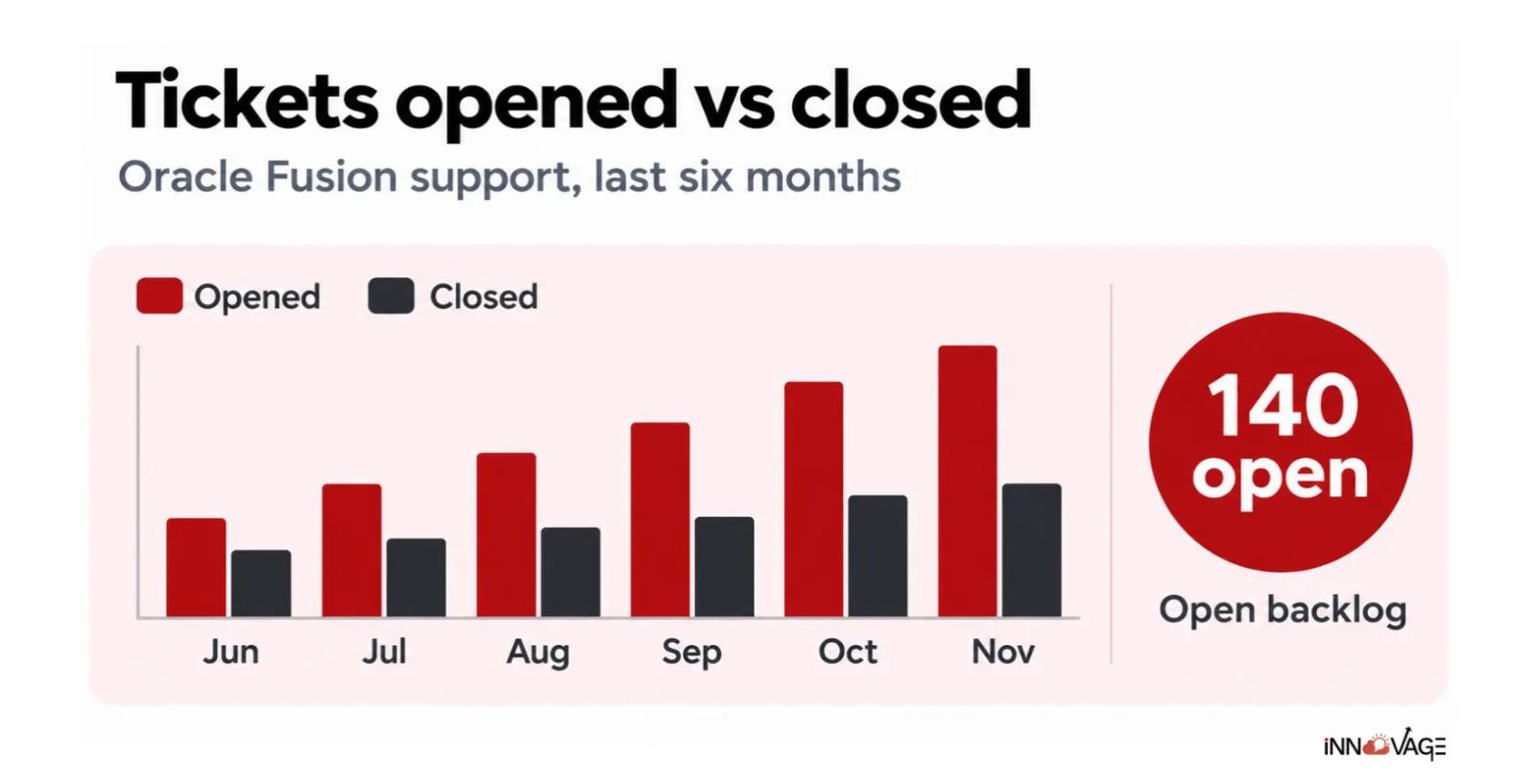
1. The backlog only grows
New tickets arrive faster than old ones are closed. Low-priority requests, the ones that would remove manual work, never reach the top of the queue.
2. One person holds all the knowledge
A single admin or ERP lead knows how the system really works. When that person is on leave, during Eid holidays for example, simple changes wait until they are back.
3. The same tickets come back
The partner applies a workaround, closes the ticket and meets the SLA. A month later, the same issue is logged again, because nobody looked for the root cause.
4. Every team fixes things its own way
Finance builds a spreadsheet. Procurement emails the admin directly. IT adds a script. Each fix makes sense alone. Together, they make Fusion harder to run.
5. Updates and compliance changes catch you off guard
Quarterly updates arrive four times a year, and in the UAE the compliance calendar is busy too: VAT, Corporate Tax and, from 2027, e-invoicing. If nobody owns testing and change, each one becomes a small crisis.
6. Nobody can say what improves next quarter
Ask who decides the next three improvements to Fusion. If the answer is a pause, there is no roadmap, and no one is accountable for one.
If three or more of these sound familiar, the issue is not your people or the software. It is how ownership is set up.
Why ticket-only support keeps Fusion stuck
Many AMS contracts in the region were written for go-live. They measure response times, resolution times and ticket counts. Those numbers matter, but they reward closing tickets, not reducing them.
A mature Oracle Fusion support model adds the work that ticket-only contracts leave out:
- Root cause analysis for repeat incidents
- A written test scope for every quarterly update
- A small, steady budget of hours for improvements, not just fixes
- Regular reviews with finance and IT to agree what changes next
- Documentation, so knowledge does not live in one person's head
It also needs the right ERP support team structure. That does not mean a large internal team. For most mid-size GCC companies, it means a small internal core (an ERP lead and one admin) working with a partner that brings functional, technical and integration skills on demand, ideally in a time zone that overlaps with the UAE working week.
A RACI for running Oracle Fusion
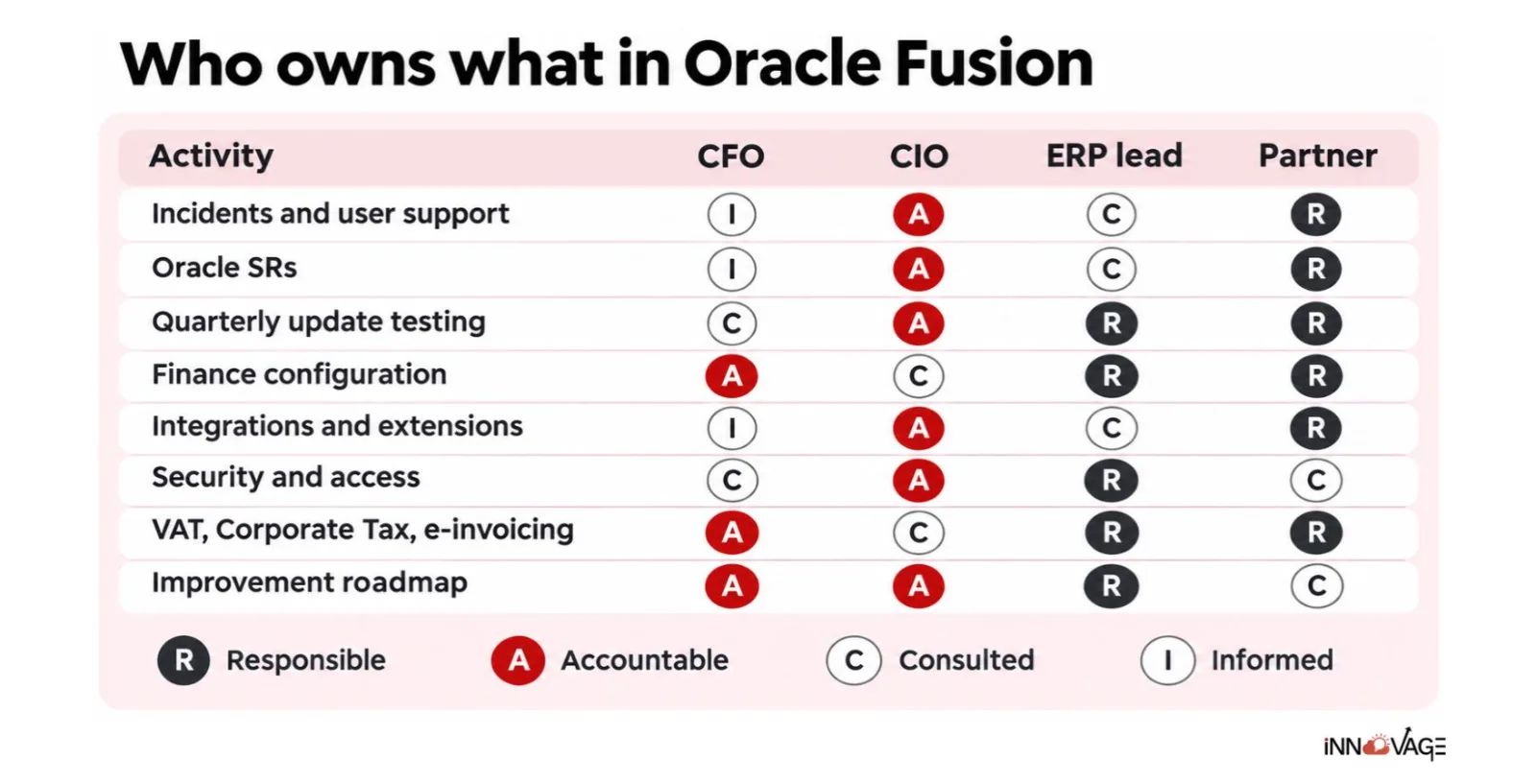
A RACI matrix names who is Responsible, Accountable, Consulted and Informed for each activity. Here is a starting point for a mature Fusion estate. Adjust the roles to fit your company.
| Activity | CFO / Finance | CIO / IT | ERP lead | Support partner |
|---|---|---|---|---|
| Incident resolution and user support | I | A | C | R |
| Oracle SRs and product issues | I | A | C | R |
| Quarterly update testing | C | A | R | R |
| Configuration changes to finance processes | A | C | R | R |
| Integrations and extensions | I | A | C | R |
| Security, roles and access reviews | C | A | R | C |
| Compliance changes (VAT, Corporate Tax, e-invoicing) | A | C | R | R |
| Improvement roadmap and priorities | A | A | R | C |
Two rules make it work. First, every activity has one accountable owner, except the roadmap, which finance and IT should own together. Second, the partner is responsible for more than incidents. If your current contract only covers the first two rows, that is the gap.
The decision: diagnose before deciding
Back in Dubai, the leadership meeting does not end with a new contract or a new hire. The CFO wants to switch partners. The ERP lead wants another admin. The CIO pushes back on both. Changing people without knowing what is broken would only move the problem.
So the team agrees on one step first: an honest look at how Fusion is configured, supported and used today. Which tickets repeat, which features were never switched on, which integrations are fragile and where the hours actually go.
That is how Act 1 ends. Three people, three problems, one cause, and a decision to diagnose before deciding.
What comes next in this series
Act 2 of Running Oracle Fusion is about fixing things in the right order.
Next week, Episode 5: before fixing anything, the team runs a health check on its Oracle Fusion setup.
Frequently asked questions
What is an ERP support model?
It is how a company organizes the people, partners and processes that keep its ERP running and improving after go-live. It defines who handles incidents, testing, configuration, integrations and the improvement roadmap.
What is ERP application support?
ERP application support is functional and technical help for how your ERP is set up and used: incidents, user questions, configuration changes, reports, integrations, extensions and update testing. On Oracle Fusion, it covers what Oracle Support does not.
What does Oracle Support cover for Fusion customers?
Oracle Support handles product defects and platform issues through Service Requests. It does not fix your configuration, custom reports, integrations or business processes. Those need internal owners or an application support partner.
How big should an Oracle Fusion support team be?
It depends on your modules, entities and integrations. Many mid-size companies run Fusion with a small internal core, usually an ERP lead and an admin, and a partner that provides functional, technical and integration skills as needed.
What is a RACI matrix for ERP?
A RACI matrix lists the main ERP activities and names who is Responsible, Accountable, Consulted and Informed for each one. It removes the gaps where everyone assumes someone else owns the work.
Ready to see who really owns your Fusion?
Innovage Cloud is an Oracle Partner with ISO 27001:2022 certification, working with Oracle Fusion customers across the GCC. Our team supports Fusion after go-live: fixing what breaks, testing every quarterly update, and helping finance and IT agree who owns what, so the system keeps getting better instead of standing still.