Why Oracle Fusion Quarterly Updates Still Hurt After a Dozen Cycles

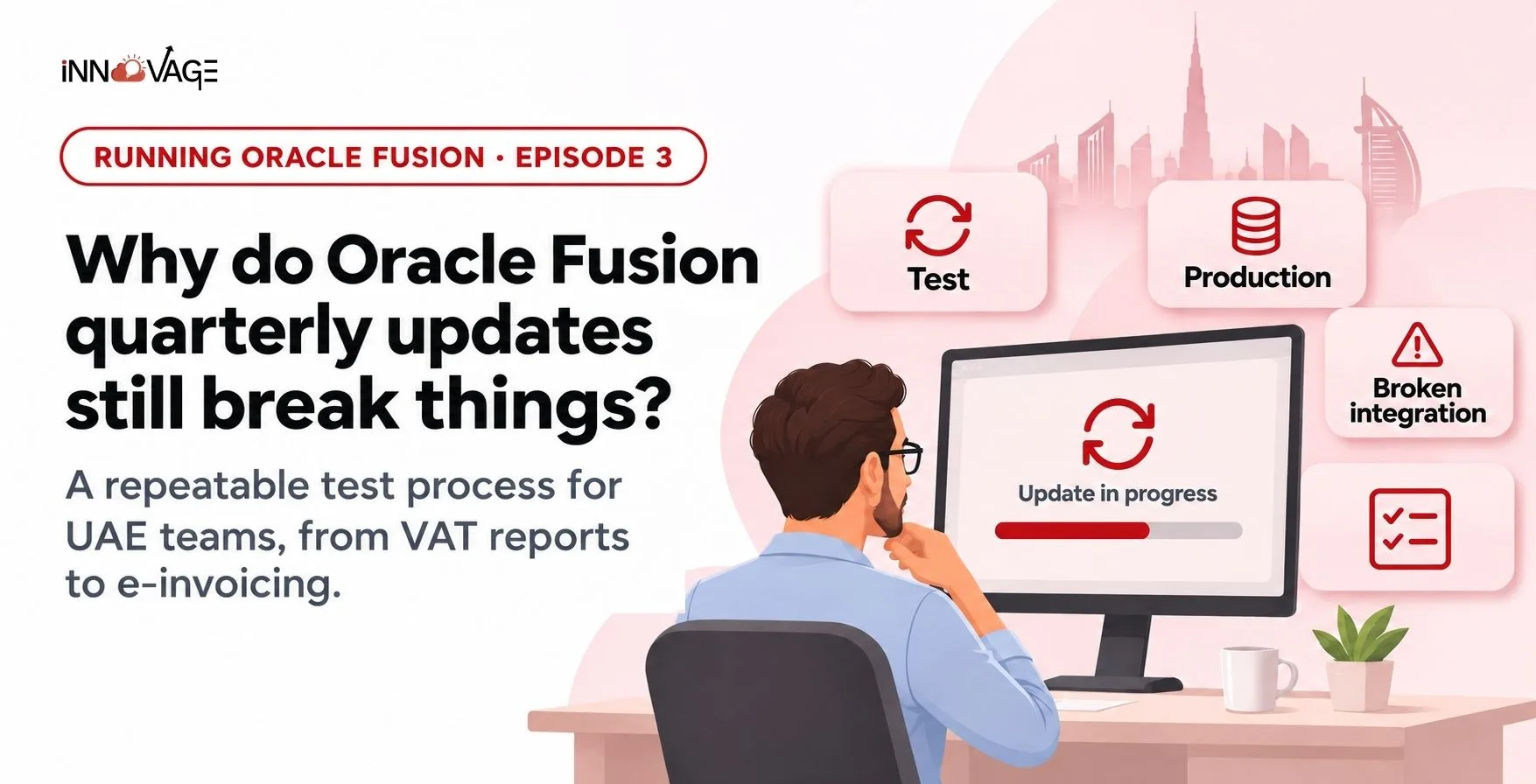
Previously, in Episode 2: finance struggled through another 10-day close. This week, the ERP lead.
Key takeaways
- Oracle updates Fusion every quarter: your Test environment first, then Production about two weeks later. Those two weeks are your testing window.
- Updates rarely break Oracle's standard features. They break what is unique to you: integrations, custom reports, personalizations, extensions and security.
- In the UAE, the highest risk sits where Fusion meets compliance: VAT returns, Corporate Tax reporting and, from 2027, e-invoicing.
- A dozen update cycles do not make a team ready. A written, risk-based test process does.
Friday, 6 PM, Dubai. The ERP lead at our composite trading and distribution group logs off for the weekend. Oracle is applying the quarterly update to Production.
Monday, 8 AM. The overnight interface that loads supplier invoices into Payables has failed. A custom report the tax team uses to prepare the VAT return now shows empty columns. Two approvers say their invoice approval screen looks different.
This is not their first update. The company has been live on Oracle Fusion for years, which means more than a dozen quarterly updates. Every one of them has meant two weeks of scramble. The Test environment was updated two weeks ago, but nobody had time to test. Finance was busy with month-end close.
Experience has not turned into a process.
What is Oracle Fusion testing, and why does every update need it?
Oracle Fusion testing is the work of checking that your configuration, integrations, reports, extensions and security still behave as expected after a change, whether that change comes from Oracle or from your own team. The most predictable change is the quarterly update.
Oracle updates Fusion Cloud Applications every quarter. Each environment belongs to an update group, and Oracle applies the update to your Test environment first, then to Production about two weeks later. That gap is deliberate. It is the window Oracle gives you to test before the update reaches the system your business runs on.
Oracle tests its own standard features. It cannot test your setup: the way your entities, approvals, integrations and reports were configured. That part is always yours, or your support partner's.
What Oracle Fusion quarterly updates usually break
After a dozen cycles, the pattern is predictable. The problems almost always show up in the same places.
- Integrations. Interfaces with banks, procurement portals, payroll providers and other systems depend on data formats and APIs that can change with an update.
- Custom reports. BI Publisher and OTBI reports built on specific fields or data models can return errors, or worse, return wrong numbers without anyone noticing.
- Personalizations and page changes. As Oracle moves more pages to the Redwood user experience, page-level personalizations may need to be redone.
- Extensions. VBCS and APEX extensions that call Fusion APIs need to be checked against each new release.
- Security and workflows. New features can come with new privileges, and approval rules can behave differently after changes.
Case study: Redwood page enablement and VBCS/APEX extensions →
The UAE angle: where updates meet compliance
For a UAE company, the most expensive update failures are not the visible ones. They are the ones that touch tax and compliance.
- VAT. VAT returns are due within 28 days of the end of each tax period. A report that breaks quietly in an update can surface right when the tax team needs it.
- Corporate Tax. Reporting that feeds Corporate Tax calculations depends on the same ledgers, mappings and reports that updates can affect.
- E-invoicing. Under the UAE's phased rollout, e-invoicing becomes mandatory from 1 January 2027 for businesses with annual revenue of AED 50 million or more, and from 1 July 2027 for the rest. Once you are live, the integration between Fusion and your Accredited Service Provider becomes something to test in every single update.
Timing matters too. If your Fusion environments are in the update group that receives updates in January, April, July and October, a quarterly update will land in the same weeks that Phase 1 e-invoicing goes live.
Getting ready for e-invoicing as well? Our UAE e-invoicing cutover and hypercare checklist covers that go-live step by step.
A repeatable test process for every quarterly update

The goal of Oracle Fusion testing is not to test everything every quarter. It is to test the right things, the same way, every time. Here is a process that works for most mid-sized Oracle ERP testing needs.
1. Read what is changing, early
Oracle publishes What's New and readiness material for every update on its Cloud Readiness site. Review it as soon as it is available, flag features that touch your modules, and decide which optional features you want to switch on.
2. Build a risk-based test scope

Rank everything you could test by business impact and by how likely an update is to affect it. Test the high-risk items every quarter, the medium ones when release notes touch them, and the low-risk ones on a rotation.
| Risk | Examples for a UAE Fusion customer | When to test |
|---|---|---|
| High | Bank and payment integrations, e-invoicing integration with your ASP, VAT return reports, payroll files for WPS if you run Fusion payroll, month-end close processes | Every quarterly update |
| Medium | Approval workflows, custom OTBI and BI Publisher reports, VBCS and APEX extensions, security roles | When release notes touch them |
| Low | Rarely used reports, standard screens without personalizations | On a rotation, once or twice a year |
3. Use the two-week window properly
Plan the window before the Test environment is updated. Book testers in advance, keep the window clear of month-end close where possible, and agree a sign-off date a few days before the Production update.
4. Automate what repeats
Regression scripts for high-risk processes run the same way every quarter, which makes them good candidates for automation. Keep manual testing for judgment calls, such as new features and changed screens.
5. Separate your fixes from Oracle's
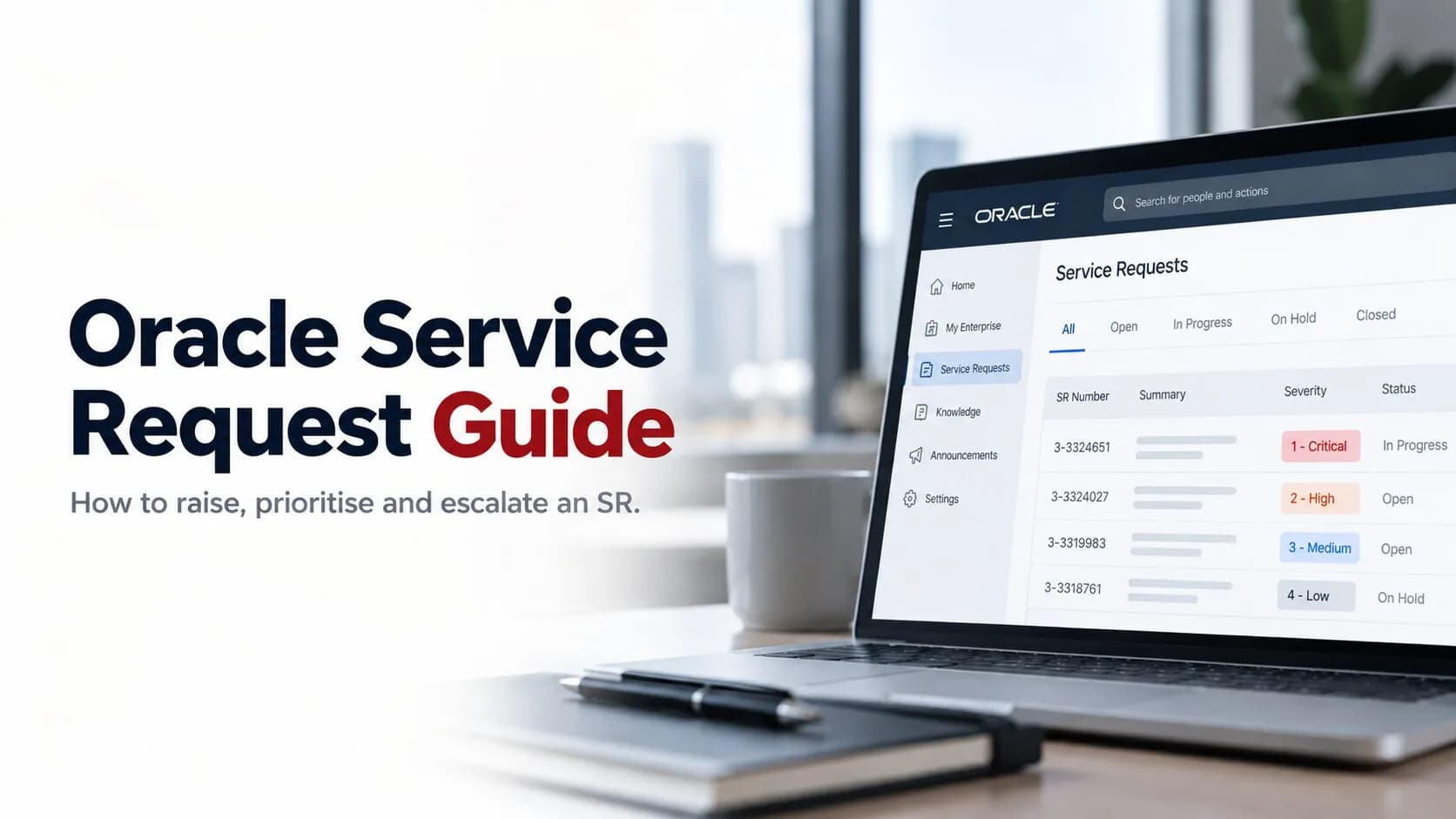
When something breaks, decide quickly whether it is your configuration or an Oracle defect. Fix configuration issues in-house or with your partner, and raise an Oracle service request for product defects. If your team is unsure which is which, our guide on how to raise a service request with Oracle explains it.
6. Keep the test pack alive
After each update, record what was tested, what broke and what changed. Add new integrations and reports to the scope as they go live. This is how experience finally becomes a process.
Plan your next update window with us →
Why a dozen cycles have not made it easier
Back in our composite company, the ERP lead knows every quirk of the system. That is part of the problem. The test approach lives in one person's head, there is no written scope, and there are no spare people when the Test environment is updated.
The support contract covers tickets, not update readiness. Finance cannot give up testers during close. So each quarter, the team tests whatever it has time for and hopes for the best.
It is the same pattern from Episode 1: nobody owns the work that keeps Fusion healthy between projects.
What comes next in this series
Finance has a slow close. The ERP lead has an update process that depends on luck. The CIO is about to put the pieces together.
Next week, Episode 4: the CIO counts the tickets and asks who actually owns Oracle Fusion now.
Ready to stop dreading the next update?
Innovage Cloud is an Oracle Partner with ISO 27001:2022 certification, working with Oracle Fusion customers across the GCC. Our team supports Fusion after go-live: fixing what breaks, testing every quarterly update, and steadily clearing the backlog.
Hand quarterly update testing to a Fusion AMS team →
Frequently asked questions
How often does Oracle update Fusion Cloud Applications?
Oracle releases updates to Fusion Cloud Applications every quarter. Each environment belongs to an update group that determines the months in which updates arrive.
How long is the gap between the Test and Production updates?
Oracle applies each quarterly update to your Test environment first, then to Production about two weeks later. That window is the time you have to test before the update reaches Production.
What should we test after an Oracle Fusion quarterly update?
Focus on what is unique to your setup: integrations, custom reports, personalizations, extensions, security roles and approval workflows. For UAE companies, include VAT reports, Corporate Tax reporting and, once live, the e-invoicing integration.
Can Oracle Cloud testing be automated?
Yes. Repeatable regression tests for high-risk processes are well suited to automation. New features and changed screens still need a person to review them.
Do Oracle Fusion updates affect UAE e-invoicing?
They can affect the integration between Fusion and your Accredited Service Provider, along with the data and reports behind it. Once e-invoicing is live, include that integration in every quarterly test cycle.