UAE E-Invoicing Penalties in 2026: What Cabinet Decision 173 Changed and How to Avoid Fines

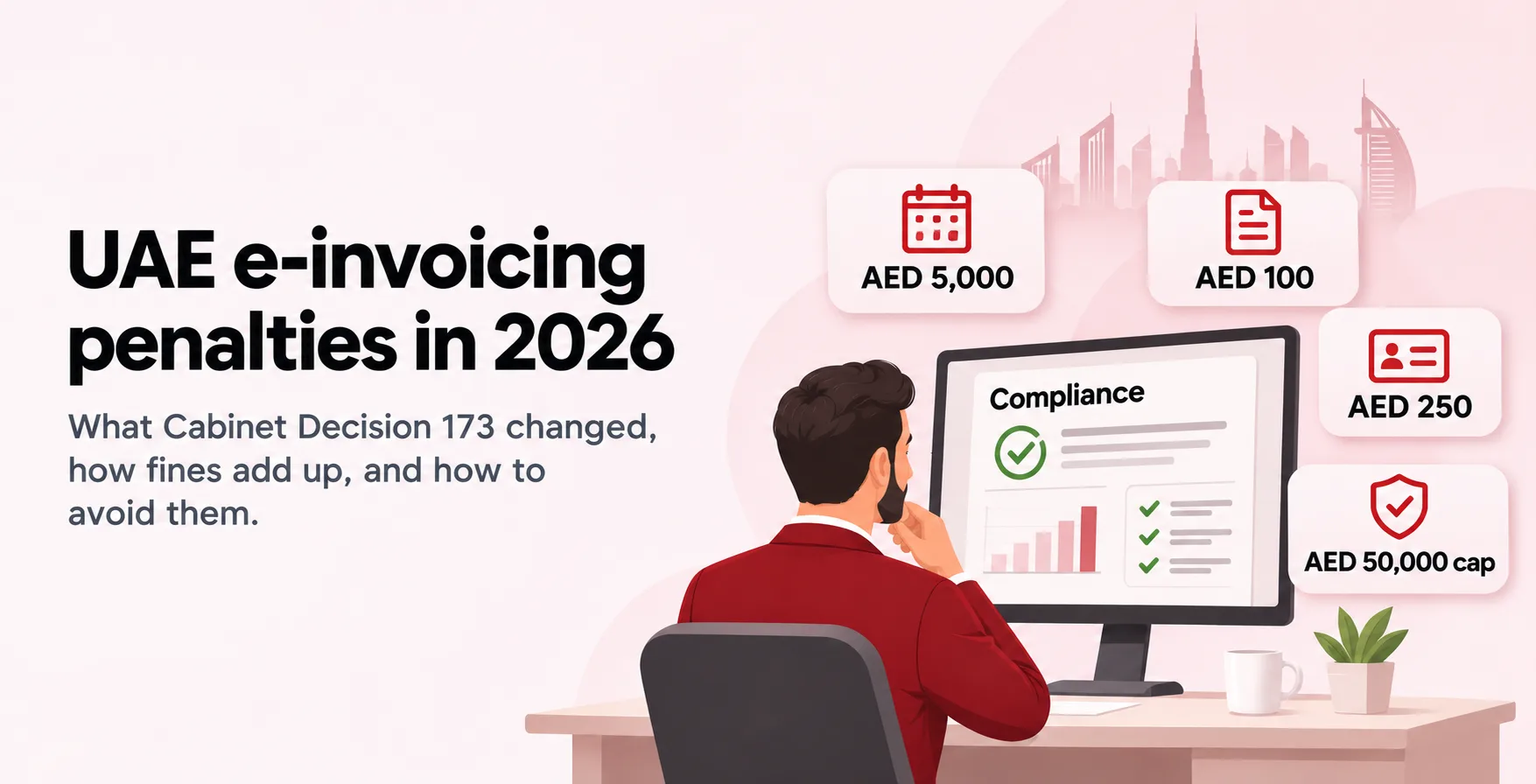
The UAE e-invoicing penalties have changed before most businesses have issued a single e-invoice. On 30 October 2026, the Ministry of Finance announced Cabinet Decision No. 173 of 2026, which repeals Cabinet Decision No. 106 of 2025 and resets the fines for e-invoicing violations. Some penalties went down, one disappeared, and one now applies to buyers as well as sellers. If your finance team built its risk view around Decision 106, it needs updating.
This guide covers every penalty in the new decision, what changed, how the fines add up in practice, and the controls that keep you out of scope.
Quick answer: Under Cabinet Decision No. 173 of 2026, failing to implement e-invoicing (including not appointing an Accredited Service Provider) costs AED 5,000, plus AED 5,000 for each month it continues, capped at AED 50,000 in any 12 months. Not issuing an e-invoice or e-credit note costs AED 100 per document, up to AED 5,000 a month each. Not telling your ASP about changes to your FTA registration costs AED 250 a day, up to AED 5,000 a month. Voluntary users are exempt.
The four e-invoicing penalties under Cabinet Decision 173
The decision has a short table of violations. Here it is in plain terms.

| Violation | Who it applies to | Penalty |
|---|---|---|
| Not implementing the e-invoicing system on time, including not appointing an Accredited Service Provider (ASP) | Issuer or recipient | AED 5,000 for the first instance, plus AED 5,000 for each month or part of a month it continues. Total capped at AED 50,000 in any 12 consecutive months. |
| A recipient that implemented e-invoicing but then stops meeting its obligations as a recipient | Recipient | Same as above, and shares the same AED 50,000 cap |
| Not issuing and transmitting an e-invoice through the e-invoicing system | Issuer | AED 100 per e-invoice, up to AED 5,000 per calendar month |
| Not issuing and transmitting an e-credit note through the e-invoicing system | Issuer | AED 100 per e-credit note, up to AED 5,000 per calendar month |
| Not notifying your ASP of changes to the data registered with the FTA | Issuer or recipient | AED 250 per day of delay or part of a day, up to AED 5,000 per calendar month |
Two rules sit around the table.
First, if you act as both issuer and recipient for the same violation, you pay one penalty, not two.
Second, the decision does not apply to anyone using e-invoicing on a voluntary basis, such as businesses that joined the pilot or went live before their phase.
What changed from Cabinet Decision 106 of 2025
Decision 106 was published in December 2025 and never applied in practice, because no business had a mandatory go-live date before it was replaced.
Most published guides still quote it, so the differences matter.

| Area | Cabinet Decision 106 of 2025 (repealed) | Cabinet Decision 173 of 2026 (current) |
|---|---|---|
| Late implementation or no ASP | AED 5,000 per month of delay, no cap. Issuers only. | AED 5,000 first instance plus AED 5,000 per month, capped at AED 50,000 in 12 months. Issuers and recipients. |
| Recipient that stops complying | Not covered | Covered, same penalty and cap |
| E-invoice not issued and transmitted | AED 100 each, max AED 5,000 a month | Unchanged |
| E-credit note not issued and transmitted | AED 100 each, max AED 5,000 a month | Unchanged |
| System failure not reported to the FTA | AED 1,000 per day, for issuers and recipients | Removed |
| Registered data changes not notified to the ASP | AED 1,000 per day, no monthly cap | AED 250 per day, max AED 5,000 a month |
| Same violation as issuer and recipient | Not addressed | One penalty only |
The system-failure penalty went together with a wider change. Ministerial Decision No. 197 of 2026 also deleted the "System Failure" definition from the main e-invoicing decision. You should still log and handle outages, but there is no longer a daily fine for reporting one late.
When do the penalties start to apply?
The decision itself is in force from the day after its publication in the Official Gazette. In practice, each penalty bites when the matching obligation applies to you.
For most businesses that means their go-live date: 1 January 2027 for businesses with revenue of AED 50 million or more, and 1 July 2027 for everyone else.
See when UAE e-invoicing applies to your business for the full phase table.
One exception is worth flagging. Appointing an ASP is itself an implementation obligation, and the Phase 1 deadline for that was 30 October 2026. If your business is in Phase 1 and has not appointed an ASP, the first penalty line may already be relevant.
Check your position with your tax adviser now rather than in January.
How the fines add up: three examples
- A late go-live. A Phase 1 company is not ready on 1 January 2027 and goes live at the end of April. That is a first-instance penalty of AED 5,000, then AED 5,000 for each further month of non-compliance. Three more months brings it to AED 20,000. Had it dragged on for ten months or more, the AED 50,000 cap would stop the total there.
- Invoices sent as PDFs. After go-live, a branch keeps emailing 300 PDF invoices a month instead of routing them through the ASP. At AED 100 each, that would be AED 30,000, but the monthly cap limits it to AED 5,000. The same branch also emails 40 credit notes. That is a separate violation with its own cap, so it adds AED 4,000. The total for the month is AED 9,000.
- A trade licence change. A company updates its address and trade licence with the FTA but forgets to tell its ASP for 12 days. That is 12 x AED 250 = AED 3,000.
The caps keep any single month predictable, but they are not a reason to relax. These fines repeat every month a problem continues, and they sit alongside your existing VAT penalties.
An invoice that never reached the buyer as an e-invoice can still create VAT exposure on both sides.
How to avoid UAE e-invoicing penalties
Almost every penalty in the decision traces back to a design or data gap that can be fixed before go-live. These are the controls we recommend building in.
Lock in your ASP and go-live plan
The largest fine is for not implementing on time, so start with your ASP contract and a realistic plan. Our 15 technical questions to ask an e-invoicing ASP help you choose, and the 8-week implementation plan shows a realistic route from contract to live.
Make receiving work, not just sending
Decision 173 now penalises recipients that fail to implement or stop meeting their obligations.
Your Payables team needs to receive, validate and process inbound e-invoices from day one. See inbound UAE e-invoicing into Oracle Fusion Payables.
Track every invoice to an accepted status
The AED 100 penalty applies when an e-invoice is not issued and transmitted, and Ministerial Decision 197 gives you 14 business days from the transaction date to do it. A rejected invoice that sits unnoticed in a queue can quietly cross that line.
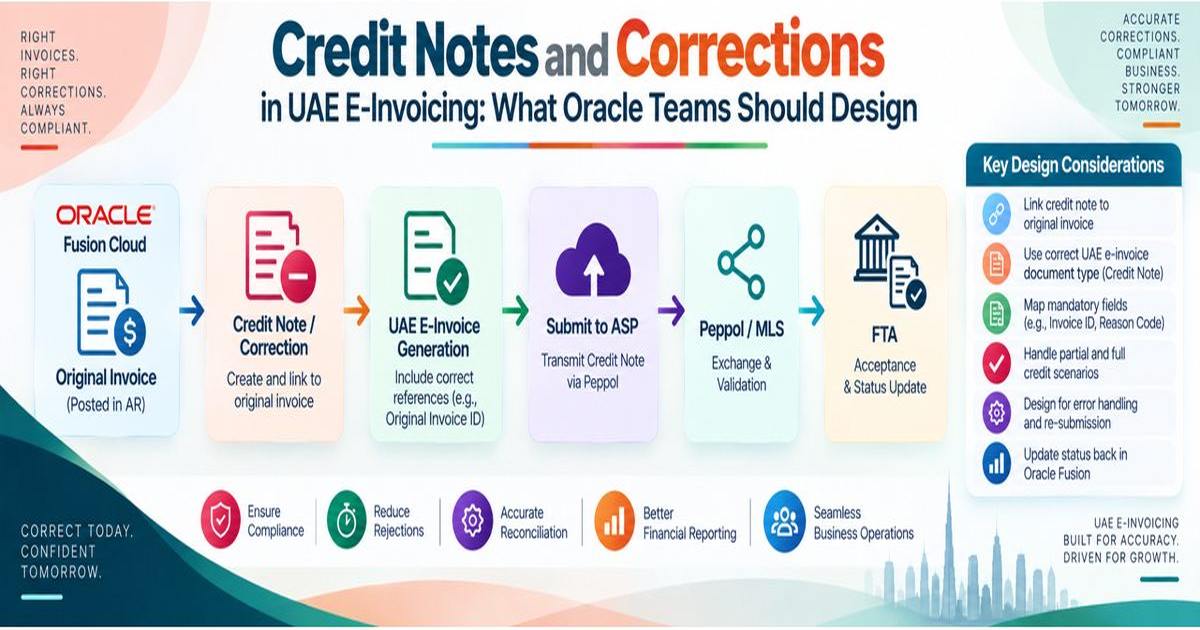
Map every ASP response to an Oracle status your team can act on, as described in our guide to e-invoicing responses and MLS status mapping. For the end-to-end flow, see UAE e-invoicing with Oracle Fusion, from AR invoice to ASP, Peppol and FTA.
Treat credit notes as their own process
Credit notes carry their own AED 100 penalty and their own monthly cap. Teams often design invoices carefully and leave credit memos for later. Our guide to credit notes and corrections in UAE e-invoicing covers what to design up front.
Keep registered data in sync with your ASP
The AED 250 daily penalty is easy to trigger by accident. Any change to your FTA registration, such as name, address, trade licence or tax group, needs a matching update at your ASP. Give one person ownership of this.
If you run several entities, it is worth reading TIN vs TRN for EmaraTax onboarding and UAE e-invoicing for multi-entity Oracle Fusion customers.
Test the failure paths before cutover
Most penalties come from what happens when something goes wrong: a rejection, a resend, an outage, a missed credit note. Run the error scenarios in UAT, not just the happy path. Use our 25 UAT scenarios and the production cutover and hypercare checklist.
Not sure where you stand? Start with our UAE e-invoicing readiness guide for Oracle Fusion.
FAQs on UAE e-invoicing penalties
What are the penalties for UAE e-invoicing non-compliance?
Under Cabinet Decision No. 173 of 2026, there are four penalty lines: AED 5,000 plus AED 5,000 a month for failing to implement (capped at AED 50,000 in 12 months), AED 100 per missing e-invoice, AED 100 per missing e-credit note (each capped at AED 5,000 a month), and AED 250 a day for not updating your ASP on registration changes (capped at AED 5,000 a month).
Is Cabinet Decision 106 of 2025 still in force?
No. Cabinet Decision No. 173 of 2026 repealed it. The Ministry of Finance announced the new decision on 30 October 2026. Any guide that quotes AED 1,000 a day for system failures or registration changes is based on the old decision.
How much is the fine for not issuing an e-invoice in the UAE?
AED 100 for each e-invoice that is not issued and transmitted through the e-invoicing system, up to AED 5,000 per calendar month. E-credit notes have the same penalty with a separate AED 5,000 monthly cap.
Do e-invoicing penalties apply during the pilot or voluntary adoption?
No. Decision 173 excludes anyone who issues, transmits, exchanges or reports e-invoices on a voluntary basis. Penalties apply once e-invoicing is mandatory for you.
Is there a maximum e-invoicing penalty?
Each penalty line has a cap. Implementation failures are capped at AED 50,000 in any 12 consecutive months. The e-invoice, e-credit note and registration-update penalties are each capped at AED 5,000 per calendar month. Caps apply per violation, so different violations can add up in the same month.
Is there still a penalty for late reporting of a system failure?
No. The AED 1,000 daily penalty for not reporting a system failure was in Decision 106 and does not appear in Decision 173. You should still have an outage process with your ASP, because invoices still need to be issued and transmitted on time.
Final thought
Decision 173 makes UAE e-invoicing penalties more proportionate, but it also makes them clearer to enforce. The fines are small per document and capped per month, which means the real cost of non-compliance is rarely one big penalty.
It is a slow leak: monthly implementation fines, repeated document fines and a finance team firefighting rejections. The fix is the same as it was before the decision changed: a working ASP connection, clean master data and a tested process for every exception.
Key Note:
Need help? Innovage Cloud can assess your Oracle Fusion, EBS or NetSuite setup against the e-invoicing obligations behind each penalty and close the gaps before your go-live. Book a UAE e-invoicing readiness assessment.
This article provides general implementation information, not tax or legal advice. Confirm current obligations, penalty amounts and dates with official UAE Ministry of Finance and FTA guidance and your adviser.