RPA vs AI: Which Automation Fits Your Finance and Operations Processes?

RPA vs AI comes down to rules versus judgement. Robotic process automation (RPA) follows fixed steps on structured data, exactly the same way every time. AI reads unstructured inputs, such as emails, PDFs and free text, and makes predictions or decisions.
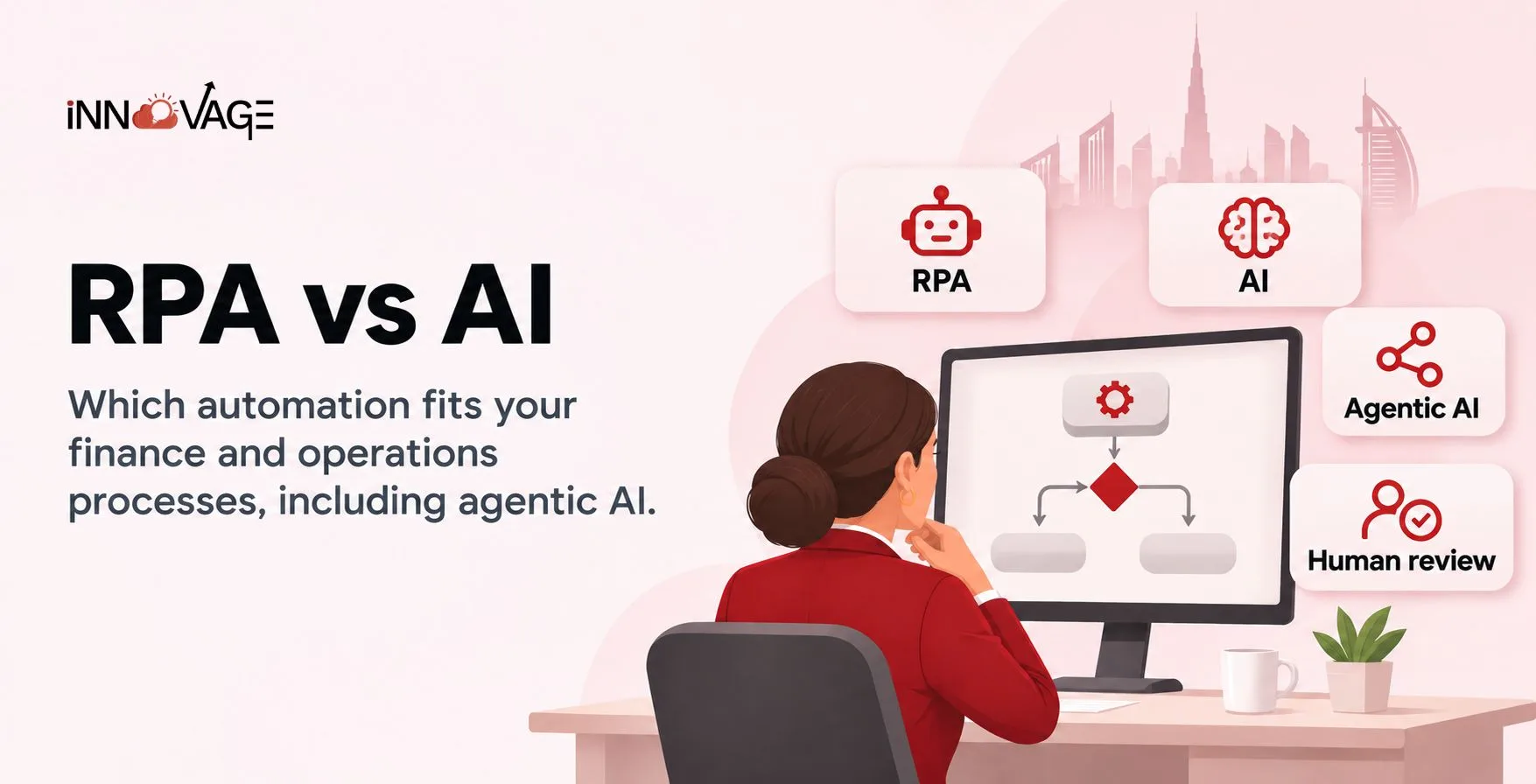
Agentic AI goes one step further: it plans and carries out multi-step tasks towards a goal, using tools and asking a person when it is unsure.
Key takeaways
- RPA is best for high-volume, rule-based work on structured data that rarely changes.
- AI is best where the input is messy or the step needs judgement: documents, exceptions, classification and prediction.
- Agentic AI suits goal-driven work that spans several systems and steps, with a person approving the important decisions.
- Most finance and operations processes need a mix. The usual pattern: AI turns documents into data, rules and RPA move the data, and people handle the exceptions.
- Choose by process, not by technology. The checklist below shows how.
What is RPA?
Robotic process automation uses software bots to copy what a person does on screen or through an API: open a file, copy a value, post a journal, send an email. You define every step in advance. If the input looks the way the bot expects, it is fast, cheap and accurate.
The weakness is the same as the strength. RPA does exactly what it was told. A new invoice layout, a renamed field or a changed ERP screen can stop it. For Oracle Fusion customers this matters, because quarterly updates regularly change pages that screen-based bots depend on.
What is AI in automation?
In automation, "AI" usually means machine learning and large language models doing work that needs reading or judgement. Typical tasks include extracting data from invoices in different layouts, classifying emails, matching transactions that do not line up exactly, flagging unusual spend and drafting replies.
AI learns from examples rather than fixed rules, so it copes with variety. The trade-off is that it gives probable answers, not certain ones. Every AI step needs a confidence threshold and a human review queue for the cases it is unsure about.
Is RPA considered AI?

No. Classic RPA is not AI, because it does not learn or decide; it follows scripted rules. The confusion comes from vendors bundling the two. Many RPA platforms now include AI features such as document reading, and many AI tools call RPA bots to act in older systems.
When someone says "AI automation", ask which steps are rules and which are judgement.
RPA vs AI: the key differences
| RPA | AI | |
|---|---|---|
| How it works | Follows fixed, scripted rules | Learns patterns from data and examples |
| Best input | Structured data: forms, ERP fields, spreadsheets | Unstructured data: PDFs, emails, scans, free text, Arabic and English |
| Output | Exactly the same result every time | A probable result with a confidence score |
| Handles change | Poorly; layout or screen changes break bots | Well; adapts to new formats with feedback |
| Time to first value | Weeks | Weeks to a few months, depending on data |
| Main risk | Brittle bots and maintenance cost | Wrong answers without review; data quality |
| Typical finance use | Payment files, bank statement uploads, report distribution | Invoice capture, match exceptions, duplicate detection, cash forecasting |
RPA vs agentic AI: what is the difference?

Agentic AI is the newest layer. An AI agent is given a goal rather than a script, such as "clear this week's unmatched receipts". It works out the steps, calls the tools it is allowed to use (an ERP API, a mailbox, a report), checks the result and asks a person when a decision is above its limit.
Enterprise software is moving this way quickly. Oracle, for example, launched AI Agent Studio for Fusion Applications in March 2025, alongside more than 50 pre-built agents, so customers can build and govern their own agents inside Fusion.
| RPA | Agentic AI | |
|---|---|---|
| Instruction | A fixed script: do step 1, then step 2 | A goal: get this outcome, within these limits |
| Decisions | None; anything unexpected becomes an error | Chooses the next step; escalates when unsure |
| Scope | One task in one or two systems | Multi-step work across several systems |
| Control | Predictable and easy to audit | Needs guardrails: permissions, approval checkpoints, logs |
| Good fit | Stable, repetitive transactions | Exception handling, investigations, requests that vary each time |
A useful way to think about it: RPA is the hands, AI is the eyes, and agentic AI is the coordinator that decides which hands and eyes to use next.
Where each fits in finance and operations
| Process | Use RPA for | Use AI for | Use agentic AI for |
|---|---|---|---|
| Accounts payable | Moving invoices from mailboxes into the ERP, payment runs | Reading invoices in any layout, spotting duplicates | Working the match-exception queue and contacting suppliers for missing details |
| Accounts receivable | Sending statements and reminders on a schedule | Matching remittances to open invoices, predicting late payers | Running a collections cycle within approved rules |
| Bank and intercompany reconciliation | Downloading statements and running standard matching | Suggesting matches for partial and many-to-one items | Investigating breaks across entities and proposing adjustments |
| Month-end close | Running reports and standard journals | Flagging unusual balances and variances | Tracking the close checklist and chasing owners |
| Procurement | Creating POs from approved requisitions | Comparing supplier quotes | Turning an emailed request into a requisition and routing it |
| Operations and HR | Employee onboarding steps across systems | Classifying service tickets and documents | Resolving routine employee and vendor queries end to end |
For a step-by-step view of one process, see our guide to procure-to-pay automation with AI for GCC finance teams.
How to choose: a 6-question checklist
Run each candidate process through these questions.
- Is the input structured? If yes, RPA or a direct integration will usually do. If it arrives as PDFs, emails or scans, you need AI to read it first.
- Do the rules ever change? Stable rules suit RPA. Frequent exceptions suit AI.
- Does a step need judgement? If a person currently "decides" rather than "copies", that step is an AI candidate.
- Does the work span several systems and steps that vary each time? That is where an agent earns its place.
- What does a wrong answer cost? The higher the cost, the stronger the human approval step needs to be, whatever the technology.
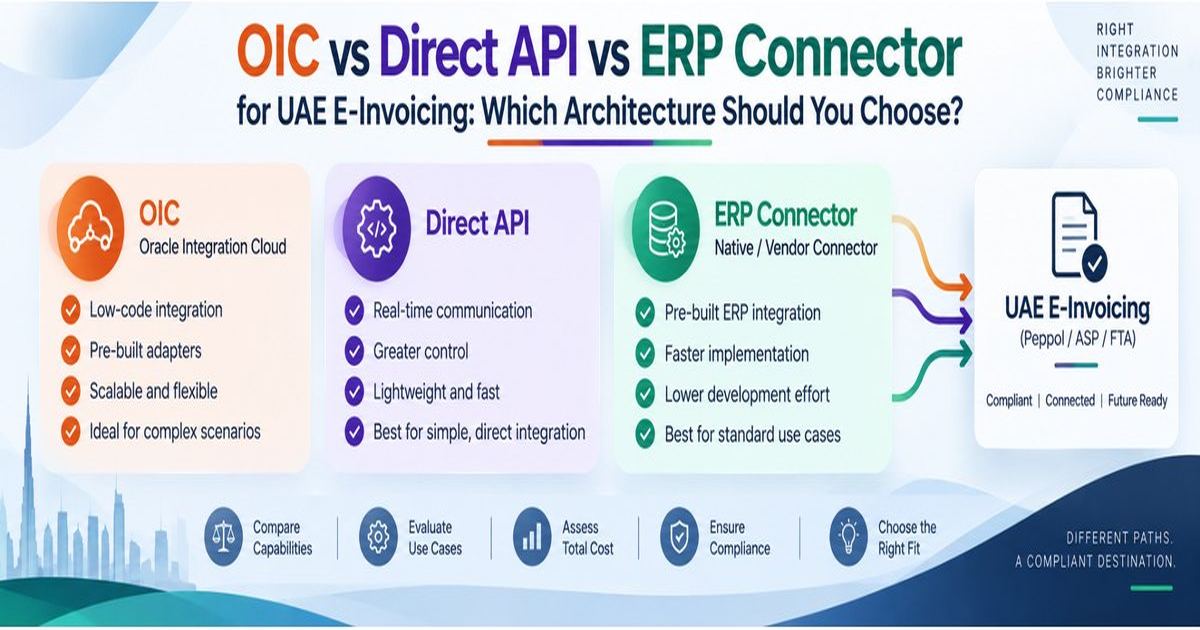
- Is there an API? If the system has one, use it. An integration through Oracle Integration Cloud or a direct API is more stable than a bot clicking through screens. Our Oracle ERP integration team sees this choice decide whether automation survives its first year.
Will AI replace RPA?
Not completely, and not soon. AI is taking over the steps RPA was never good at, such as reading documents and handling exceptions. But a fixed, auditable rule is still the cheapest and safest way to run a stable transaction. In practice, RPA is becoming one of the tools an AI agent calls, rather than a separate programme. Existing bots on stable processes are worth keeping; bots that break every month are worth replacing with APIs or AI.
A practical example: one invoice, three technologies
A supplier emails a PDF invoice in Arabic and English to the AP mailbox.
- AI reads the PDF, extracts the supplier, TRN, lines and VAT, and gives each field a confidence score.
- Rules and RPA check the supplier against the master, create the invoice in the ERP and apply match tolerances.
- An agent picks up the price mismatch, checks the PO history, emails the buyer for confirmation and, once approved, releases the hold.
- A person approves anything above the agent's limit and reviews low-confidence fields.
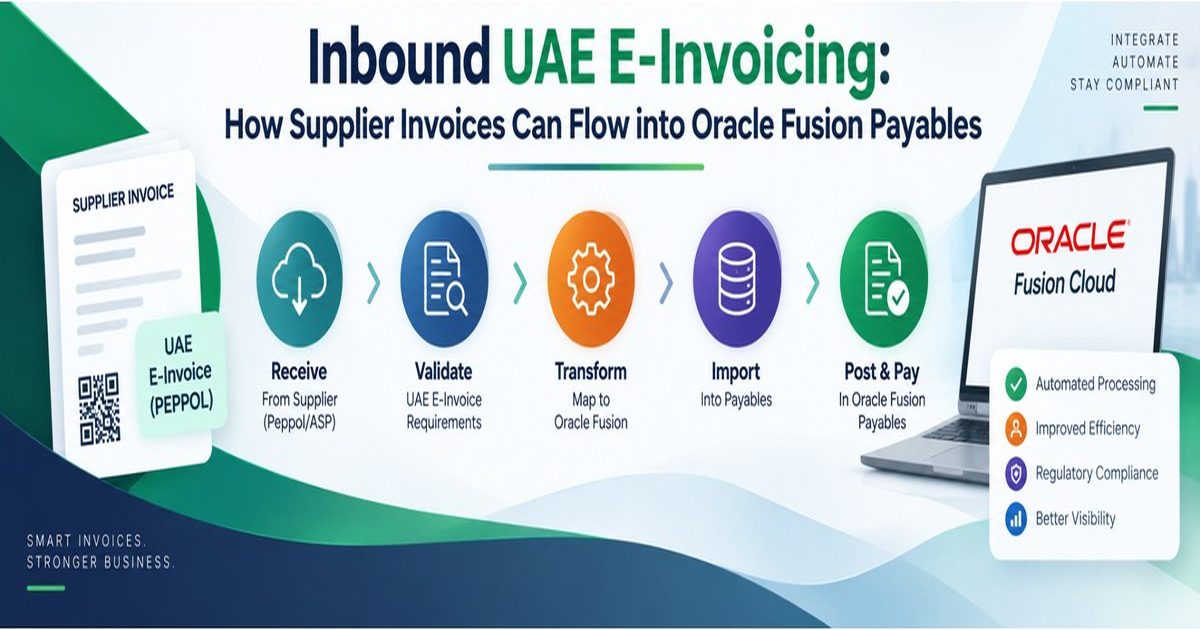
In the UAE, this flow is about to change. From 2027, structured e-invoices will replace many PDFs, so the "read the document" step shrinks and the integration and exception steps matter more. See inbound UAE e-invoicing into Oracle Fusion Payables.
Common mistakes to avoid
- Choosing the tool first. Start from the process and its pain points, then pick the technology for each step.
- Automating a broken process. A bot running a bad process just makes mistakes faster.
- Building screen bots on cloud ERPs. Quarterly updates break them. Use APIs and integration platforms where you can.
- Skipping the human review step. AI and agents need confidence thresholds, approval limits and an exception queue, especially early on.
- Giving agents too much access. Apply least-privilege permissions and log every action. The NIST AI Risk Management Framework is a useful reference for setting these controls.
- Not measuring a baseline. Record cycle time, touchless rate and cost per transaction before you start, or you cannot prove the result.
Why this matters now for UAE and GCC teams
Three things are pushing GCC finance and operations teams to decide now. Oracle and other ERP vendors are building agents directly into their applications.
UAE e-invoicing starts in January 2027, turning many document-reading tasks into data-integration tasks. And the UAE's National Strategy for Artificial Intelligence 2031 sets a clear national direction for AI adoption across sectors.
Teams that map their processes now can decide where RPA, AI and agents each belong, instead of adding tools one at a time.
Frequently asked questions
What is the difference between RPA and AI?
RPA follows fixed rules to repeat tasks on structured data, the same way every time. AI learns from data to read unstructured inputs such as PDFs and emails and to make predictions or decisions. RPA does; AI reads and decides.
Is RPA considered AI?
No. Traditional RPA does not learn or make decisions, so it is not AI. Many automation platforms now combine RPA with AI features like document reading, which is why the two are often confused.
What is the difference between RPA and agentic AI?
RPA runs a fixed script. Agentic AI is given a goal, plans the steps, uses tools such as ERP APIs and email, checks results and escalates to a person when unsure. RPA suits stable tasks; agents suit multi-step work that varies.
Is an AI agent better than RPA?
Not always. For stable, high-volume transactions, RPA or a direct integration is cheaper, faster and easier to audit. Agents are better for exceptions, investigations and requests that change each time.
Will AI replace RPA?
AI will replace RPA for document-heavy and judgement-based steps. For stable rule-based steps, RPA and APIs remain the simplest option, and increasingly they are tools that AI agents call.
Can RPA and AI work together?
Yes, and most finance processes need both. A common pattern is AI to read documents, rules and RPA to move data through the ERP, and people or agents to handle exceptions.
Which finance processes should we automate first?
Start with high-volume processes that have a measurable pain point, such as invoice capture, match exceptions, bank reconciliation or collections. Baseline them first, then pilot on one entity before scaling.
How Innovage Cloud helps
Innovage Cloud is an Oracle Partner with offices in Dubai and Ahmedabad. We help GCC finance and operations teams decide where RPA, AI and agents each fit, then build them around Oracle Fusion, EBS and NetSuite:
- Process assessment: map each process, baseline the KPIs and score every step for rules, AI or agent.
- Automation delivery: our business process automation practice builds and runs the bots, AI models and agents, including Invox for AI invoice processing.
- Oracle AI: Oracle AI consulting for OCI AI services and agents that work inside your Oracle applications.
- Integration: APIs and Oracle Integration Cloud so automation does not depend on fragile screen bots.
Book a 30-minute automation assessment. We will review one process with you and show which steps suit RPA, AI or an agent.
This article provides general information, not legal or compliance advice. Confirm data protection, audit and regulatory requirements for your sector before automating decisions.