
UAE E-Invoicing Data Dictionary: PINT-AE Field Mapping Guide


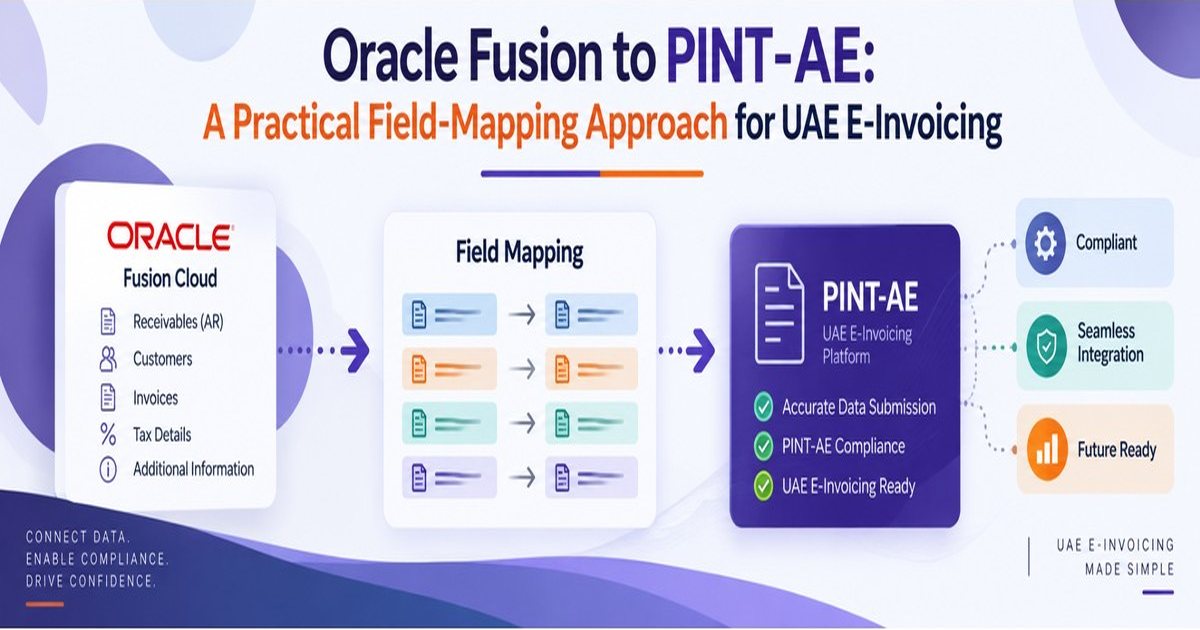
A UAE e-invoicing data dictionary turns regulatory and PINT-AE requirements into field-level decisions that finance, tax, ERP and integration teams can build and test.
For Oracle Fusion and other enterprise systems, it is the bridge between an invoice on screen and a complete structured invoice that can pass validation, move through an Accredited Service Provider (ASP), and be reconciled afterwards.
What is an e-invoicing data dictionary?
A data dictionary is a controlled inventory of every invoice element required by the target format and by the business. It records the meaning of each field, its source system, format, validation rules, transformation logic, owner and test evidence. It is more useful than a one-time spreadsheet because it becomes the shared reference for implementation and change control.
Why it matters for UAE e-invoicing
The UAE model uses structured XML and PINT-AE. A visually correct PDF does not prove that mandatory or conditional data is present in the structured payload. Small differences in party identifiers, tax categories, unit codes, document references, allowances, charges or totals can create validation failures, delivery issues or reconciliation work.
Recommended data-dictionary columns
| Column | Purpose |
|---|---|
| Business element | Plain-language name, such as seller tax identifier, buyer address, invoice line or payment reference. |
| PINT-AE path and rule | Target XML location, cardinality and whether it is mandatory, conditional or optional. |
| Source and owner | Oracle Fusion, CRM, warehouse, tax engine or another source, with an accountable data owner. |
| Transformation | Code conversion, concatenation, defaulting, derivation or calculation required before exchange. |
| Validation and evidence | Format checks, business rules, sample values, exception process and test result. |
Fields that need early attention
- Supplier and buyer identity: legal names, addresses, participant identifiers, tax registrations and the correct party role.
- Document identity: invoice number, issue date, currency, document type and references to preceding invoices or credit notes.
- Invoice lines: descriptions, quantities, unit codes, item identifiers, price, discounts and charges.
- Tax and totals: tax categories, rates, exemption or special-treatment reasons, taxable amounts, tax amounts and payable total.
- Operational data: purchase-order, contract, delivery, project or payment references required by the relevant scenario.
How to build the dictionary
- Inventory every invoice and credit-note scenario across each legal entity and source system.
- Map source fields to the applicable PINT-AE rules and identify gaps, duplicates and manual workarounds.
- Decide whether each missing field must be remediated, derived, collected earlier in the process or handled as an exception.
- Agree validation ownership between business teams, the integration team and the ASP.
- Test representative and edge-case samples using the PINT-AE Invoice Validator, then retain the results as implementation evidence.
Oracle Fusion implementation considerations
Do not assume a standard Oracle extract contains all required information in a usable form. The mapping should identify the Fusion table, descriptive flexfield, customer account, tax configuration, receivables transaction source or external application that owns every target element. It should also define what happens when an element is blank or incompatible with the required code list.
Mandatory fields for structured UAE e-Invoicing
The supplied Data Dictionary describes the essential elements used across tax invoices, tax credit notes, self-billing and related scenarios. It identifies 50 minimum fields for tax invoices and 49 for commercial invoices in XML format, with additional conditional fields expected in the complete Data Dictionary.
Invoice Details
| Field | Data Dictionary Requirement |
|---|---|
| Invoice Number (IBT-01) | Unique invoice identifier for traceability and compliance. |
| Invoice Issue Date (IBT-02) | Mandatory issue date in YYYY-MM-DD format. |
| Invoice Type Code (IBT-03) | Functional type, such as standard invoice or credit note, using UNTDID 1001 |
| Transaction Type (BT UAE-02) | Flags for transaction types such as Free Trade Zone and Deemed Supply. |
| Invoice Currency (IBT-05) | ISO 4217 alpha-3 currency code. |
| Payment Due Date (IBT-09) | Mandatory where the payment amount is greater than zero. |
| Business Process and Specification Identifier | Peppol billing context and identifier for semantic-content and business-rule requirements. |
| Payment Means Type (IBT-081) | Expected settlement method using UNCL4461 codes. |
Seller and buyer details
Mandatory party data covers legal name, electronic address and scheme identifier, legal registration identifier and type, TRN and VAT scheme, address line, city, country subdivision and country code. The supplied guidance states that seller and buyer TRNs are 15 alphanumeric digits, beginning with 1 and ending with 03. UAE country subdivisions use the appropriate emirate code, such as DXB, AUH, SHJ or RAK.
| Seller Fields | Buyer Fileds |
|---|---|
| Name (IBT-027), Electronic Address (IBT-034), Legal Registration Identifier (IBT-030) | Name (IBT-044), Electronic Address (IBT-049), Scheme Identifier (IBT-049-1) |
| TRN (IBT-031), VAT Scheme (IBT-031-1) | TRN (IBT-048), VAT Scheme |
| Address Line (IBT-035), City, Country Subdivision (IBT-039), Country Code | Address Line (IBT-050), City (IBT-052), Country Subdivision (IBT-054), Country Code (IBT-055) |
Document totals and tax breakdown
- Sum of Invoice Net Amount (IBT-106)
- Invoice Total Amount Without Tax (IBT-109)
- Invoice Total Tax Amount (IBT-110)
- Invoice Total Amount with Tax (IBT-112)
- Amount Due for Payment (IBT-115)
- Tax Category Taxable Amount (IBT-116)
- Tax Category Tax Amount (IBT-117)
- Tax Category Code (IBT-118) and Rate (IBT-119)
Totals must reconcile to the relevant line and tax-category values. The guidance specifies that standard-rate category tax equals taxable amount multiplied by the tax rate divided by 100.
Invoice-line fields
The line-level requirements include Invoice Line Identifier (IBT-126), Invoiced Quantity (IBT-129), Unit of Measure Code (IBT-130), Invoice Line Net Amount (IBT-131), Item Net Price (IBT-146), Item Gross Price (IBT-148), Item Price Base Quantity (IBT-149), Item Tax Category Code (IBT-151), Item Tax Rate (IBT-152), VAT Line Amount (BT UAE-08), Item Name (IBT-153), and Item Description (IBT-154).
Traditional VAT invoice versus structured e-Invoice
| Aspect | Tax Invoice(Current) | e-innvoice |
|---|---|---|
| Format | PDF or paper accepted | Structured XML/UBL |
| Mandatory fields | Supplier and buyer details, TRN, invoice date, description, quantity, pricing, discount, AED totals, tax and reverse-charge statement where applicable | Structured mandatory and conditional data fields in XML/UBL |
| Real-time reporting | No | Yes |