

Oracle VBCS, VBS
Difference Between VBCS and VBS in Oracle Using Object Type Global Variable
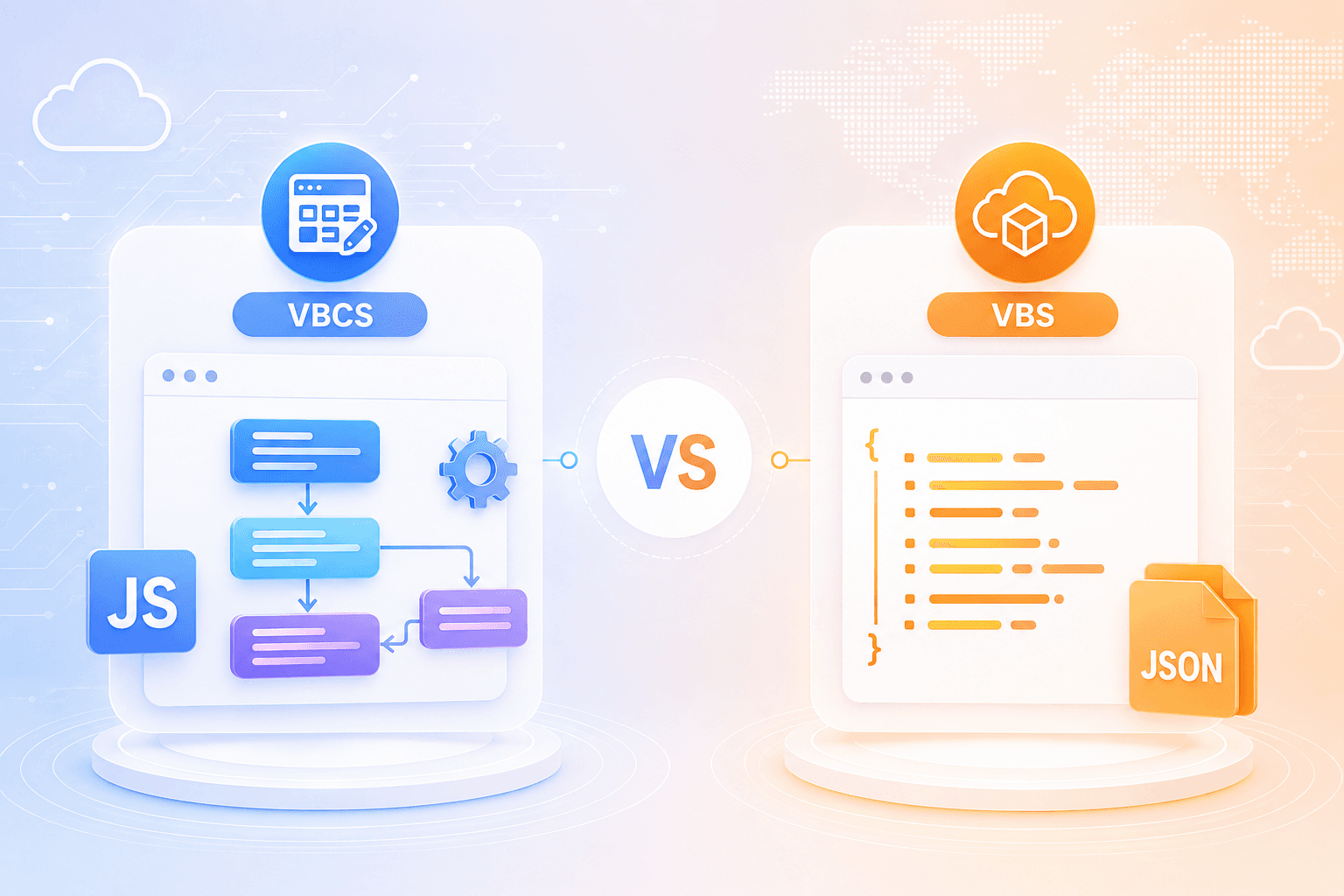
Oracle provides both Visual Builder Cloud Service (VBCS) and Visual Builder Studio (VBS). Although their names sound similar and both belong to Oracle's development ecosystem, they serve distinct purposes and support different parts of the application-development lifecycle. This guide explains those differences and helps you choose the appropriate tool.
What Is VBCS?
Visual Builder Cloud Service is a cloud-based development platform for creating web and mobile applications with minimal coding. It offers a visual environment where developers can drag and drop components, build user interfaces, integrate back-end services, manage application data, and rapidly deliver applications without extensive programming knowledge.
Key Features of VBCS
Low-Code Development
Create applications quickly through a visual, low-code approach that is accessible to business users and citizen developers.
Responsive Design
Build responsive applications that work across desktops, tablets, smartphones, and other devices.
Integration Capabilities
Connect easily to Oracle Cloud services and third-party applications to build cohesive end-to-end solutions.
Data Management
Connect to REST APIs, Oracle databases, and other data sources to manage and manipulate application data.
What Is VBS?
Visual Builder Studio is a broader development environment that extends beyond application construction. It is designed for professional developers and teams, providing a complete toolset for lifecycle management, collaboration, source control, build automation, and deployment.
Key Features of VBS
Integrated Development Environment
Use a robust IDE with advanced coding capabilities, custom code support, dependency management, and Git-based version control.
Collaboration Tools
Support code reviews, issue tracking, project management, and coordinated development across teams.
Application Lifecycle Management
Manage development, testing, deployment, and maintenance with CI/CD capabilities for efficient delivery and updates.
Multiple Language Support
Work across multiple programming languages and frameworks when a project requires capabilities beyond low-code development.
When to Use VBCS vs VBS
Object-Type Global Variables
When an application needs to share a structured value across pages or flows, an object-type global variable can group related properties in one reusable object. In VBCS, the variable supports application UI state and action-chain data. In VBS, the same application-level implementation can be developed collaboratively, versioned in Git, reviewed, and delivered through managed build and deployment pipelines.
Conclusion
VBCS and VBS are both valuable parts of Oracle's ecosystem, but they target different audiences and use cases. VBCS prioritizes rapid low-code application development, while VBS provides professional development, collaboration, version control, and lifecycle management. Understanding these differences helps teams choose the right tool—or use both together—for faster and more reliable Oracle application delivery.