

Oracle VBCS
Java Script Action Chain VS JSON Action Chain
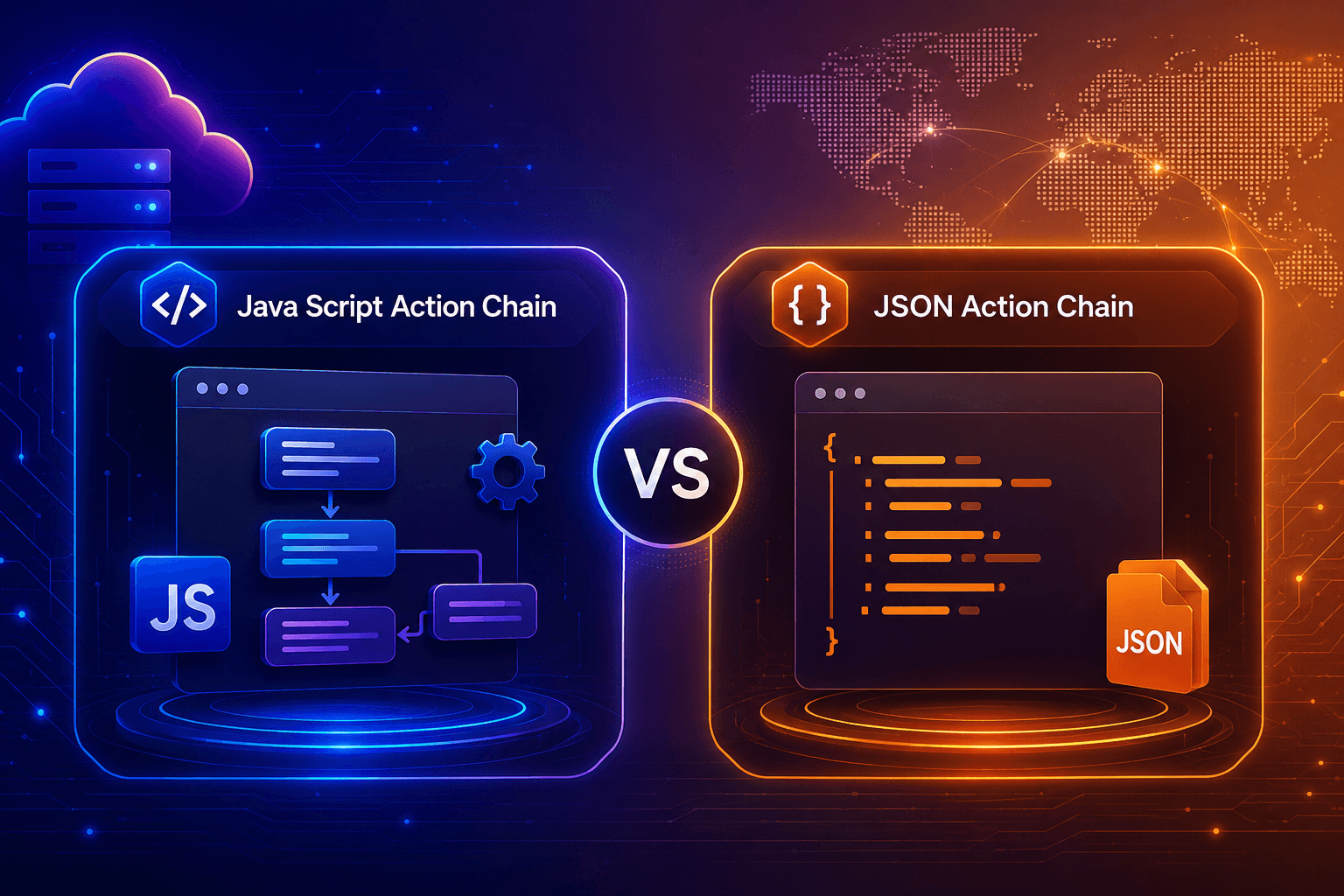
When developing applications in Oracle Visual Builder Cloud Service (VBCS), developers can use either JavaScript action chains or JSON action chains. This comparison explains why JavaScript action chains are generally more efficient and useful than JSON equivalents for complex, interactive applications.
Flexibility
Dynamic Functionality
JavaScript action chains support more dynamic and complex functionality. Developers can write custom JavaScript for specific logic, making advanced features easier to implement.
Direct Access to APIs
JavaScript action chains can call REST APIs directly and manipulate returned data in real time, providing greater control over application behavior.
Event Handling
JavaScript provides robust event-handling capabilities, allowing developers to respond to user interactions more effectively.
Custom Code
- Reusability: JavaScript functions can be reused across multiple action chains, reducing redundancy and improving consistency.
- Debugging and Testing: JavaScript provides stronger debugging tools and error-handling mechanisms, making development issues easier to identify and fix.
Performance Considerations
Enhanced User Experience
- Responsive UI: JavaScript supports interfaces that update in real time without full-page reloads.
- Rich Interactivity: Developers can create complex UI interactions, animations, and transitions that are difficult to achieve with JSON action chains.
Limitations of JSON Action Chains
Static Nature
JSON action chains are more static and are primarily suited to straightforward data manipulation rather than highly dynamic behavior.
Limited Functionality
They cannot call JavaScript action chains directly, limiting their ability to use the full power of JavaScript in application workflows.
Complex Logic Is Harder to Manage
Complex business logic can become cumbersome in JSON and may require a more declarative approach that feels less intuitive to developers familiar with imperative programming.
Conclusion
Both JavaScript and JSON action chains have a place in VBCS, but JavaScript action chains provide stronger flexibility, performance, and user experience for demanding applications. JavaScript enables dynamic, responsive, feature-rich workflows, while JSON remains useful for simpler, structured operations. The right choice depends on the complexity and interaction requirements of the application.